
Garry Otton
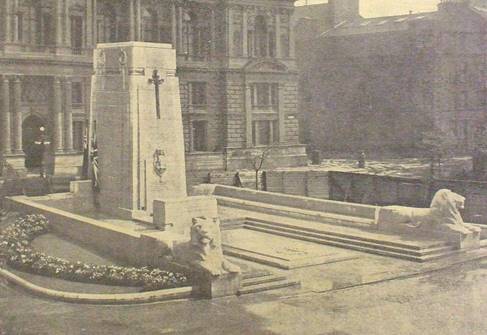
Glasgow’s war memorial was created to mourn a city’s dead, but its Christian imagery also helped civic leaders turn a turbulent public square into patriotic, quasi-sacred ground. A century later, the cross raises a simple question: whom does a civic memorial represent?
After the First World War, Britain faced grief on an unprecedented scale. Many bodies were never identified or returned, leaving families without graves. Memorials therefore became substitute tombs: places where private sorrow could be expressed publicly. Yet one question was disputed from the beginning – should these monuments be Christian?
London’s Cenotaph offered one answer. Its architect, Edwin Lutyens, deliberately excluded a cross. Prime Minister David Lloyd George also wanted a secular memorial, capable of honouring the dead “irrespective of creed or caste”. Soldiers from across the British Empire had been Christian, Spiritualists, Jewish, Muslim, Hindu, Sikh, followers of other traditions, or of no faith at all. Lutyens regarded an imposed cross as inherently exclusionary. Even the word cenotaph – Greek for an empty tomb – predated Christianity.
The Catholic Herald called it a “pagan monument” unfit for a Christian country while the public kicked back against the church and establishment. The slogan ‘Honour the dead – remember the living’ became a popular rallying cry. In 1922, 25,000 unemployed veterans marched on the Cenotaph and Westminster Abbey. Instead of wearing their military medals, they pinned pawn tickets to their coats to show they had been forced to pawn their bravery awards just to buy food.
Glasgow chose differently. Its Cenotaph, designed by Sir John James Burnet was unveiled in George Square on 31 May 1924. It stands directly before the City Chambers, the architectural statement of Glasgow as the former “Second City of the Empire”. The location matters. George Square was where volunteers had enlisted in 1914, but it was also a centre of post-war political unrest.
Returning soldiers encountered unemployment, poverty and overcrowded housing. The rent strikes, the campaign for a forty-hour week and the 1919 Battle of George Square made the area synonymous with working-class protest. ‘Red Clydeside’, the establishment media reported disparagingly.
Glasgow Corporation’s War Memorial Committee excluded Labour politicians, trade unions and working-class representatives. The Corporation, controlled by an anti-socialist coalition, wanted remembrance to emphasise common British sacrifice and civic duty rather than class conflict or pacifism.
The Christian character reinforces that purpose. A downward-pointing bronze cross sword, gilded in gold leaf on the Cenotaph closely resembles a cross. The altar-like monument also includes St Mungo, Glasgow’s patron saint, the city’s coat of arms and biblical inscriptions. One face quotes John 15:13: “Greater love hath no man than this, that a man lay down his life for his friends.” Another carries “Their name liveth for evermore”, adapted from Ecclesiasticus.
Why was a cross considered necessary? The most sympathetic answer is that Christianity supplied a familiar language for sacrifice, death and hoped-for redemption. Most Glaswegians in the 1920s identified culturally with Christianity, and bereaved families could understand the fallen through the image of Christ laying down his life for others. Burnet said the memorial should express not only grief but “the spirit of sacrifice and achievement”. A sword-cross fused military courage with Christian self-sacrifice, turning battlefield death into a morally meaningful offering.
But the cross did more than console. It gave religious authority to a political story. Soldiers were presented not simply as victims of industrial warfare or imperial rivalry, but as Christ-like figures whose deaths secured peace and demanded loyalty from the living. Christian symbolism allowed civic and military leaders to sanctify both sacrifice and the social order commemorating it.
This creates a problem. A public war memorial is not a church monument. It commemorates everyone from the city who died, including people whose faith was unknown, non-Christian or absent. Saying that the cross represented the majority does not make it universal. The Commonwealth War Graves Commission has similarly argued that its Cross of Sacrifice reflects the faith of most soldiers while remaining meaningful to all faiths. Yet a symbol cannot be both specifically Christian and religiously neutral merely because officials declare it so.
That matters in contemporary Scotland. In the 2022 census, only 38.8 per cent of the population identified as Christian. Glasgow today contains many religions and a large non-religious population.
The Chair of the Scottish Secular Society, Neil Gregory has asked: “Who exactly did God save? And can we categorically state that all those who gave their lives in war were Christian? If not, there can be no reason for such a public war memorial having a Christian cross.”
The cross on Glasgow’s Cenotaph was not required to remember the dead. Whitehall proved that a powerful national memorial could remain secular. In Glasgow, Christianity was chosen because it offered consolation, translated death into sacrifice and helped the Corporation reclaim George Square for patriotic British authority. Those reasons explain the cross; they do not make it necessary.
Glasgow’s war memorial still performs the patriotic work it was built to perform, but in an age of far-right mobilisation, social-media division and imported culture wars, the sight of Christian crosses and Union Jacks gathered around a civic space of mourning feels increasingly removed from the reason so many Scottish men gave their lives.
A civic memorial should allow every bereaved family and every citizen to stand before it without being told what faith gives the dead meaning. The dead need dignity, memory and gratitude. They do not need to be converted.
Garry Otton 2026
Full article and pictures: –