
Garry Otton
That was a question posed in an article I wrote over the summer of 2026 about war memorials. I sent it to The National who had printed my article on war hero Archibald Dickson, but they weren’t interested so I shared it with other secularists on the Scottish Secular Society and Secular Scotland Facebook pages. But that wasn’t the end of it…
After the First World War, Britain faced grief on an unprecedented scale. Many bodies were never identified or returned, leaving families without graves. Memorials therefore became substitute graves: places where private sorrow could be expressed publicly. Yet one question was disputed from the beginning – should these monuments be Christian?
London’s Cenotaph offered one answer. Its architect, Edwin Lutyens, deliberately excluded a cross. Prime Minister David Lloyd George also wanted a secular memorial, capable of honouring the dead “irrespective of creed or caste”. Soldiers from across the British Empire had been Christian, Spiritualists, Jewish, Muslim, Hindu, Sikh, followers of other traditions, or of no faith at all. Lutyens regarded an imposed cross as inherently exclusionary. He used the word cenotaph – Greek for an empty tomb – which predated Christianity.
The Catholic Herald called it a “pagan monument” unfit for a Christian country while the public kicked back against the church and establishment. The slogan ‘Honour the dead – remember the living’ became a popular rallying cry. In 1922, 25,000 unemployed veterans marched on the Cenotaph and Westminster Abbey. Instead of wearing their military medals, they pinned pawn tickets to their coats to show they had been forced to pawn their bravery awards just to buy food.
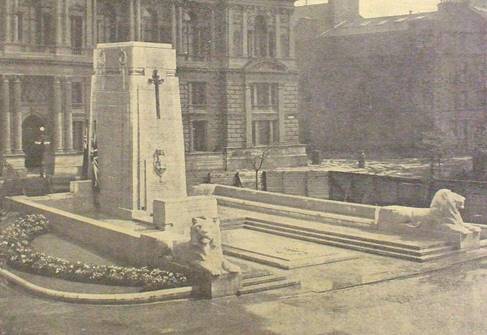
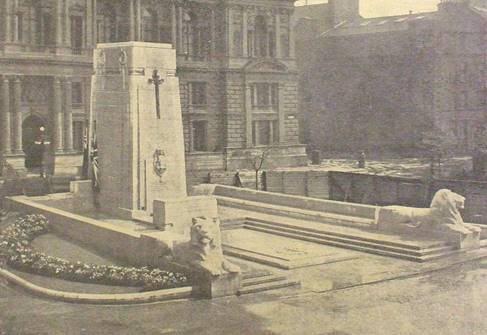
Glasgow chose differently. Its Cenotaph, designed by Sir John James Burnet was unveiled in George Square on 31 May 1924. It was criticised for standing directly before the City Chambers, concealing this architectural statement of Glasgow as a former “Second City of the Empire.” The location matters. George Square was where volunteers had enlisted in 1914, but it was also a centre of post-war political unrest.
Returning soldiers encountered unemployment, poverty and overcrowded housing. The rent strikes, the campaign for a forty-hour week and the 1919 Battle of George Square made the area synonymous with working-class protest. The establishment media reported them disparagingly as ‘Red Clydeside.’
Glasgow Corporation’s War Memorial Committee excluded Labour politicians, trade unions and working-class representatives. The Corporation, controlled by an anti-socialist coalition, wanted remembrance to emphasise common British sacrifice and civic duty rather than class conflict or pacifism.
The ‘Cross of Sacrifice’ reinforces that purpose. A downward-pointing bronze cross sword, gilded in gold leaf on Glasgow’s Cenotaph closely resembles a cross. The altar-like monument also includes St Mungo, Glasgow’s patron saint, the city’s coat of arms and biblical inscriptions. One face quotes John 15:13: “Greater love hath no man than this, that a man lay down his life for his friends.” Another carries “Their name liveth for evermore”, adapted from Ecclesiasticus. It is, for all intents and purposes a Christian memorial.
Why was a cross considered necessary? The most sympathetic answer is that Christianity supplied a familiar language for sacrifice, death and hoped-for redemption. Most Glaswegians in the 1920s identified culturally with Christianity, and bereaved families could understand the fallen through the image of Christ laying down his life for others. By placing a cross on the war memorial likens the struggle of the soldiers to a crusade and their sacrifice to the good of mankind, like that of Jesus. Burnet said the memorial should express not only grief but “the spirit of sacrifice and achievement”. A sword-cross fused military courage with Christian self-sacrifice, turning battlefield death into a morally meaningful offering.
But the cross did more than console. It gave religious authority to a political story. Soldiers were presented not simply as victims of industrial warfare or imperial rivalry, but as Christ-like figures whose deaths secured peace and demanded loyalty from the living. Christian symbolism allowed civic and military leaders to sanctify both sacrifice and the social order commemorating it.
This creates a problem. A public war memorial is not a church monument. It commemorates everyone from the city who died, including people whose faith was unknown, non-Christian or absent. Saying that the cross represented the majority does not make it universal.
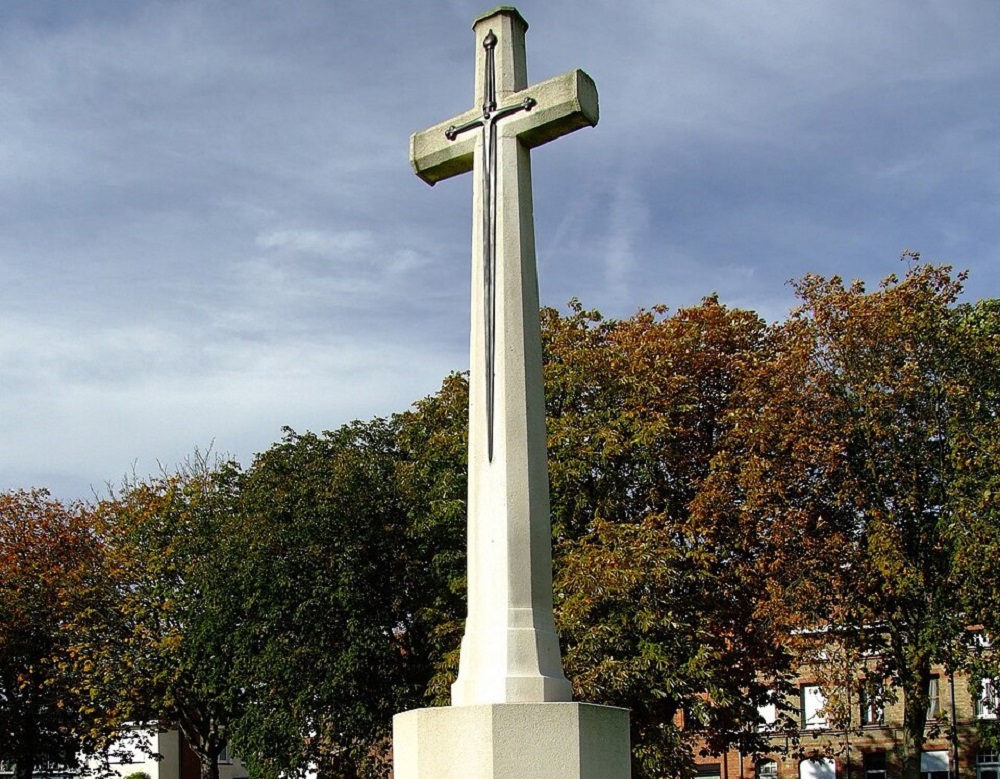
The Commonwealth War Graves Commission (CWGC) was founded by Major-General Sir Fabian Ware who was born into the strict Protestant Plymouth Brethren sect. He and his graves registration units placed thousands of wooden crosses to mark temporary burials across the Somme and other battlefields. In a more egalitarian move, the CWGC later planted rectangular white headstones for all soldiers, regardless of their rank, class, or religion. A cross was engraved directly onto the face of the stones of Christian servicemen and a large Cross of Sacrifice – a cross to look like a sword, designed by Sir Reginald Blomfield – was erected as a central monument in cemeteries containing more than 40 graves.
Fabian Ware argued that “the Cross of Sacrifice reflects the faith of most soldiers while remaining meaningful to all faiths.” Yet a symbol cannot be both specifically Christian and religiously neutral merely because an official declares it so.
That matters in contemporary Scotland. In the 2022 census, only 38.8 per cent of the population identified as Christian. Glasgow today contains many religions and a large non-religious population.
The Chair of the Scottish Secular Society, Neil Gregory has asked: “Who exactly did God save? And can we categorically state that all those who gave their lives in war were Christian? If not, there can be no reason for such a public war memorial having a Christian cross.”
The cross on Glasgow’s Cenotaph was not required to remember the dead. Whitehall proved that a powerful national memorial could remain secular. In Glasgow, Christianity was chosen because it offered consolation, translated death into sacrifice and helped the Corporation reclaim George Square for patriotic British authority. Those reasons explain the cross; they do not make it necessary.
Glasgow’s war memorial still performs the patriotic work it was built to perform, but in an age of far-right mobilisation, social-media division and imported culture wars, the sight of Christian crosses and Union Jacks gathered around a civic space of mourning feels increasingly removed from the reason so many Scottish men gave their lives.
A civic memorial should allow every bereaved family and every citizen to stand before it without being told what faith gives the dead meaning. The dead need dignity, memory and gratitude. They do not need to be converted.
After an £20.5million revamp, George Square was preparing to fully open by November 2026. Scottish Secular Society Chair, Neil Gregory wrote to Glasgow City Council requesting the removal of the cross on the Glasgow Cenotaph as a proposal for a more inclusive Glasgow in keeping with the Council’s stated aims. It was never a realistic ambition: The memorial was Category B listed in 1970. The intention was to open the debate and hopefully increase understanding with a plaque describing its history.
Approaching Glasgow Evening Times drew a curious response. Following an eager proposal to write a story, Neil Gregory was interviewed. The story that broke a few days later was unexpected. Turf being laid in George Square! Aaron Richardson, the journalist working on the story got back to Neil Gregory to ask: “Before I send it to my editor I have been asked to get a second source for this. Do you have any politicians – an MSP or councillor – that shares your views that we could speak to for another reference?” There wasn’t. There is no MP, MSP or councillor that publicly promotes atheism or secularism. There is however, a large proportion that declare their Christian beliefs from the First Minister down. The story was buried.
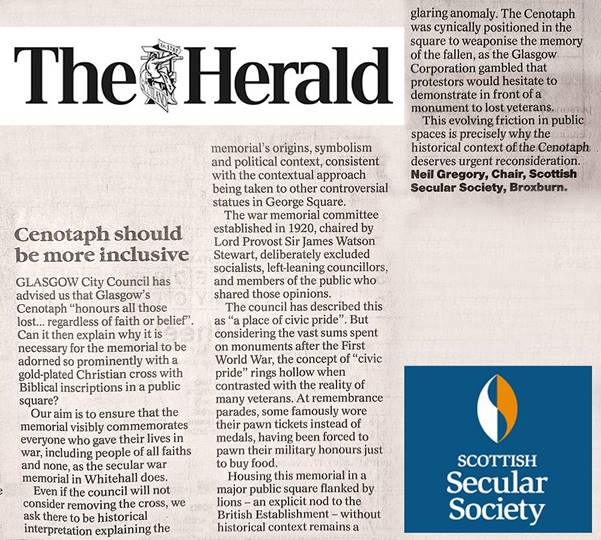
Neil Gregory’s letter was printed in both The Herald and The Scotsman on 20 October 2026 suggesting the Glasgow “Cenotaph should be more inclusive.” He asked: “Even if the council will not consider removing the cross, we ask there to be historical interpretation explaining the memorial’s origins, symbolism and political context, consistent with the contextual approach being taken to the other controversial statues in George Square.”
Glasgow City Council wrote back: “We can confirm there are no plans to make any changes to the Cenotaph as part of the George Square development project. Unveiled in May 1924, the Cenotaph is a public memorial and place of Civic Pride to remember all those lives lost to the First World War and now honours all those lost in subsequent conflicts regardless of faith or belief.”
It was careless to exclude people of no faith. It is a common Christian trope to label atheism a belief. Calling atheism a belief is like calling bald a hairstyle.
The letter also undermined Glasgow City Council’s claims of being “inclusive.” A recent post on Facebook declared Glasgow is for “all faiths and beliefs. And people.” Then in the comments under the poster declared.” Glasgow is home to people of many faiths and beliefs, and people of no faith.” The Council appeared confused.
Former Secular Scotland Chair, Robert Canning posted: “Unfortunately, the cross/sword symbol is clearly NOT “regardless of faith or belief.” It has especial regard to one faith only, which today is followed by fewer than half the population. There is therefore a disjunction between that aspect of its design and the purpose the council wishes it to serve, and that will become more blatant as the Christian population percentage continues to decline. The council needs to think about how we commemorate the future fallen, as well as those of past conflicts whose courage and sacrifice had nothing to do with Christianity.”
Referring to Glasgow Cenotaph’s origins in the 20s, another former Secular Scotland Chair, Leslie Thomson wrote: “Many of them should read the Naomi Mitchison poem, ‘Blitz on Clydebank, 1941’ in which she not only attacked the Nazis, but capitalism for the filth and squalor which Glaswegians lived in.
“Drawers of dividends,
Either as wage or share,
Ourselves had made such things
The whole end of man.
We built the tenements
That crashed and crumbled to filth.
God was no part of the plan.
We must take the weight of the blame.
Clydeside is Scotland’s shame,
And was before they came
With death cross on their wings.”
To express their outrage, when they saw Neil Gregory’s letter, the Scottish Daily Express unfairly described how the “woke” Scottish Secular Society was wanting to “tear down” the cross. To support their outrage, they got former Tory MP for Stirling, Stephen Kerr who, after being ousted from Parliament by his constituents, had returned as an unelected List MSP for Central Scotland to call it “political correctness gone mad.” Without any sense of his irony, he added, “trying to manufacture outrage over a Christian cross on a historic war memorial is… a distraction from what these monuments are actually there to commemorate.” Another List MSP, Thomas Kerr of Reform UK said: “rule out any change before Remembrance Sunday… Treating the Christian cross on Glasgow’s Cenotaph as a problem that needs explaining is a shameful insult to our war dead. The monument exists to honour the sacrifice of those who gave their lives, not to satisfy the latest set of demands from nutty, hard left campaigners with no regard for our history. We are a Christian country…” And UKIP founder Dr Alan Sked who dismissed it as “an opportunistic attempt to gain publicity for the practically unknown Scottish Secular Society… Gregory’s whining epistle merely demonstrates the failure of our secularists to appreciate the faith of others.” He declared “almost all” who died were Christian.
But it was the standalone posts on Facebook by The Herald, the far-right Scottish Daily Express and a Facebook group called Scottish Loyalists that really stirred the cesspool of social media.
Thousands of posts, many hidden by Facebook for using threats or bad language saturated the debate with hate, division and a profound ignorance of historical facts. This is a selection (spelling and punctuation as they appeared): –
“It’s very obviously a sword.”
“The Devil really is trying to takeaway all that is good and holy.”
“Get Tae… I’m an atheist but accepting of the fact Britain’s established religion is christianity.”
“Ffs, stop trying to erase Christianity from everything whilst you pander to islamism.”
“The cross STAYS.. that’s the whole top and bottom of it.. if someone doesn’t like it.. tough!!!”
“IT IS NOT A CROSS IT IS A SWORD.”
“Has Neil Gregory served I wonder?”
“He should be hanged like a tractor!”
“There’s that word again, ‘inclusive’ we know what that’s going to be.”
“Glasgow needs to be a less inclusive City. It’s unrecognisable from what it was 10 or 15 years ago.”
“Because Christ is the way, the truth, and the life. All may come to Him in their own time.”
“What the fek is the herald all about , always for others but never our own.”
“wtf.”
“Nah it disnay…”
“when will the crescent moon be going up.”
“Has heil Gregory had his hard drive 💾 searched just asking for a friend.”
“Touch that Cenotaph and there’s going to be a riot.”
“Even if it was a cross, it was here 1st! You don’t go to someone else’s country and demand they change for you, you assimilate.”
“Mibby, if we put a keffiyeh scarf around it and a Free Palestine banner, would that be ok?”
“Bring in Donald Trump! Stop pandering to this woke nonsense.”
“Lefty’s being leftys.”
“The world would be a better place without these woke degenerates.”
“The woke idiots are destroying this country on purpose so that they can turn it into a communist republic and flood it with illegal immigrants,,,, well holt onto your hats because that will never happen!!!! Lest we forget.”
“Tell the cts to do one.”
“This is this SNP and GCC RAT’S that’s doing this to OUR CITY.”
“Don’t let the Lefties burn your country.”
“If they cant live by our beliefs then they shouldn’t be here , they wouldn’t change for us if we settled in their country .. we need to stop this as its getting out of control.”
“Trying to rewrite our history.”
“Only deviant people want to do that.”
“If brains were chocolate they would not have enough to fill a smartie.”
“Jail the CANTS who suggested this and send them to a roof top in gaza. Ps enjoy Christmas you hypocritical bar stewards.”
“That’s what they do everywhere I know because they is a beautiful library on Tollcross Road and they are in their just now making it into a mosque and the pub across the road is getting turned into a car park for them and all their fancy big cars.” (Glasgow City Council had approved selling the Category B listed building for £175,000 to Hector House (Glasgow) Ltd, a care home and community organisation company.)
“Remove the Scottish Secular Society ! They obviously have an agenda to make you do as they want. What’s secular about that ?”
“Secular society! Who the fk are they? Don’t tell me it’s the lefty twats and Islamists….with a bit of green thrown in.”
express newspaper s say SNPNWANT MUSLIM NAMES TO DOMINATE THE MEMORIAL ASAP DIVERSITY LAWS RULE NON MUSLIMS.”
“Where is the voice of the Church of Scotland nowadays… not those celebrating a “lemonade and gingernut” communion of a watered down Jesus, but the voice of a former Scottish morality! Most will hate what I have said because understanding will not be there.”
“You are bheasts.”
The outrage, fuelled by irresponsible media and its users, was manufactured by people who had never encountered Neil Gregory, the mild-mannered father, Hearts fan and current Chair of the Scottish Secular Society. He was intelligent, empathetic and considerate in all his posts in response to the few who seemed prepared to engage in polite discussion.
A video post from Listed far-right MSP Thomas Kerr only fuelled the debate with misrepresentation and falsehoods in his video post while Catholic Church activist Martin Conroy’s letter in The Herald supported the war memorial being Christian because he claimed it “reflects the faith of the overwhelming majority of Glasgow’s war dead.” On the other hand, the Catholic Church was fully behind the establishment of state-funded Muslim schools.
Secularists campaign for the separation of church and state, so it’s no surprise we don’t support a Christian cross in a public square. But the Scottish Secular Society did defend a giant cross outside a church in Dundee in 2016 when there was a campaign for its removal.
Context is important here. The Glasgow Cenotaph was unveiled in 1925. British Prime Minister Lloyd George had supported a secular memorial which was built in Whitehall, so it was surprising to see so many ‘loyalists’ supporting Scotland’s efforts to go it alone.
The war dead would have mostly been Christian, but also Spiritualists (enough of them to fill the Albert Hall for a seance after the war), Jewish, Sikhs, Hindus, Humanists and Theosophists, (their headquarters still open in Glasgow. There were even followers of Mohammedanism – which is what Islam was called then – amongst the British. The reality was that there were many people who gave their lives for this country of all faiths and none.We are not zealots. Secularists are not “tearing down” the cross. That’s just nonsense. It’s a Category B listed building. But we are hoping for a plaque explaining the history of the Glasgow Cenotaph in the same way it is explained on other controversial statues in the square.
Thousands of illiterate and ill-informed posts on social media have proved how important that now is.
Garry Otton 2026
Full article and pictures: –