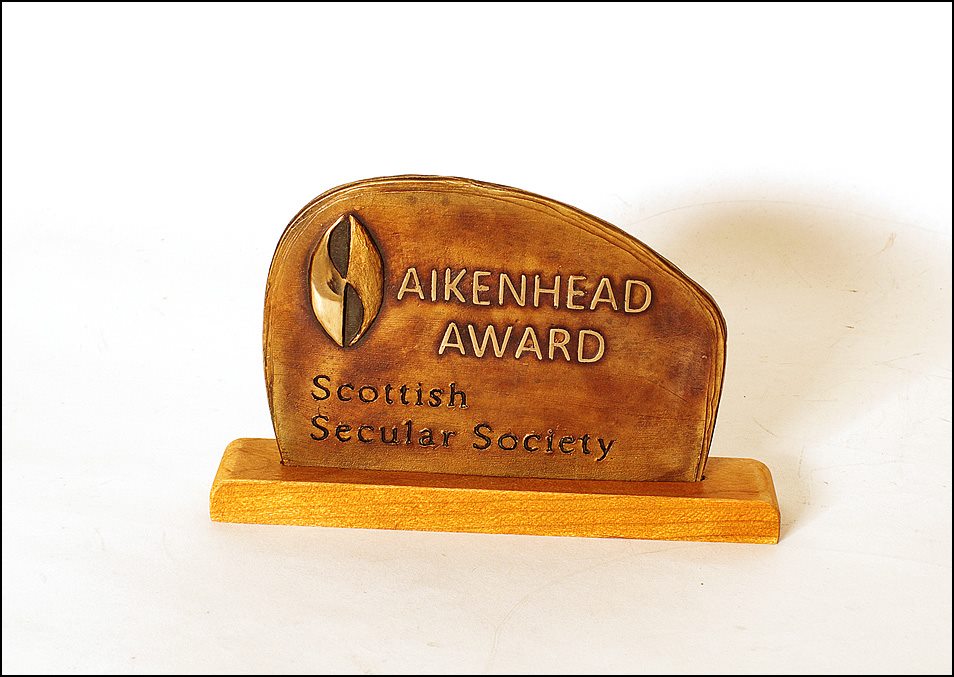
The Scottish Secular Society’s inaugural 2015 Aikenhead Award won by Raif Badawi
Blasphemy in Scotland (From John Fraser and Tom Aikenhead to Raif Badawi)
Garry Otton
John Fraser was a merchant’s apprentice, a bookkeeper who fell foul of the blasphemy statutes of 1661 and 1695 that punished profanity and wickedness at a time when Scotland was in the theocratic grip of magistrates whose religious zealotry was rewarded with incentives by the Scottish Privy Council. They were allowed to keep a share of the fines in return for their co-operation. If they refused, they were fined and replaced by those who could.
King William III by Cornelius Johnson
In late seventeenth century England, King William III (‘King Billy’ or William II in Scotland) was busy defending the country from a French invasion and ridding the world of ‘popery’. Scotland was a dark place where Presbyterian ministers burnt witches and hounded young girls to death simply for playing on Sundays. Ministers, elders and deacons ruled over their parishioners with an iron fist ready to banish those unwilling to toe the line with excommunication and all the social and legal ostracism it carried with it. Parishioners guilty of sins like fornication, adultery, slander, assault or breaches of the Sabbath would be made to demonstrate their shame, sitting on a stool of repentance in church amongst the congregation, often in special clothing or wearing a hat emblazoned with words describing their sin.
John Fraser was charged with denying, impugning, arguing and reasoning against the being of God, saying, “there was no God to whom men owed that reverence worship and obedience so much talked off” and claimed established religion was made to “frighten folks and to keep them in order”. When asked what religion he was, Fraser was supposed to have replied that he didn’t have one and was an Atheist. More than enough to have him dragged before the Privy Council.
Fraser argued that he’d been misunderstood. That this was a product of a conversation he had with Robert Henry and his wife, a couple from whom he rented lodgings. Fraser had been reading, as one contemporary put it: “ill books which corrupt and ensnare curious fancies”. A book by Charles Blount was mentioned, but facing a long jail term, he wisely chose to label him a “notorious blasphemer” whilst boosting his Christian credentials with a casual mention of his more normal bedtime reading: Truth of the Christian Religion by Dutch author Hugo Grotius. Fraser, like the author Charles Blount, wasn’t an atheist; simply a critic of religion who saw a different end for the human spirit and argued that the world was older than 6,000 years. Robert Henry and his wife had stormed off after Fraser’s blasphemous utterances leaving him little chance to put things right until breakfast. By that time, Mrs Henry had already reported him to the moral police.
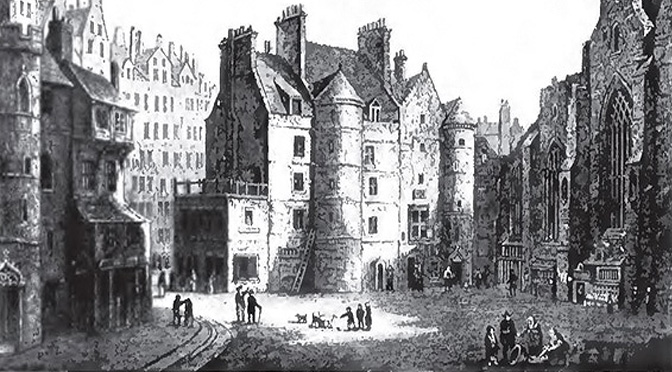
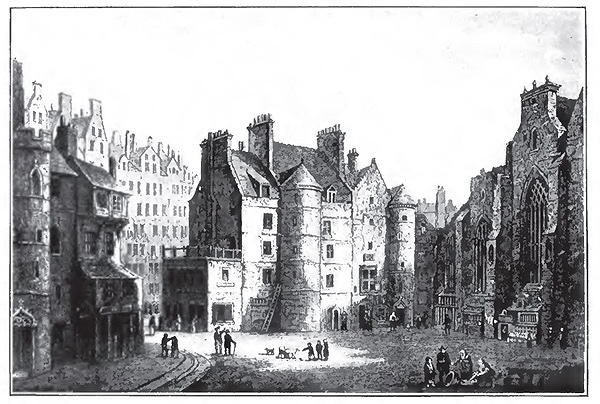
Fraser was locked-up in Edinburgh’s tollbooth in sackcloth. He was still there after they had arrested a young Edinburgh student by the name of Tom Aikenhead and hung him for blasphemy.
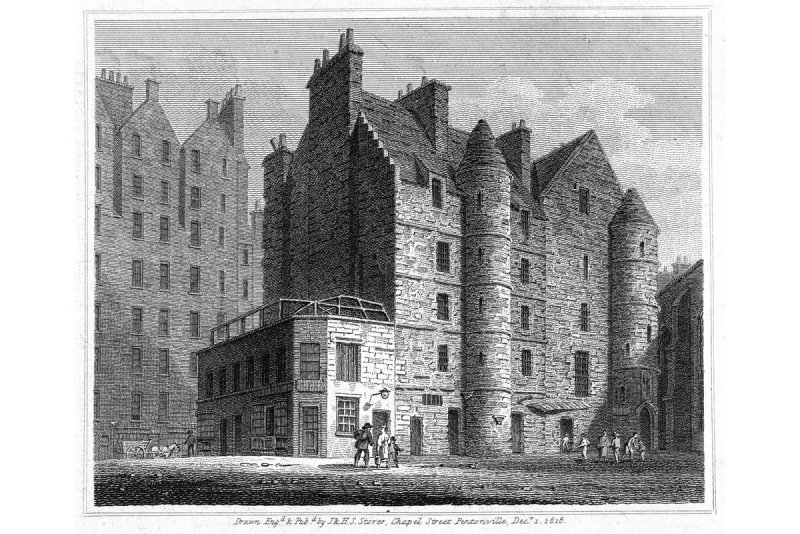
Edinburgh’s tollbooth
While England’s pamphlets, periodicals and booksellers enjoyed more intellectual freedom with the lapsing of their Licensing Act, Scottish Christians clamped down on any influx of forbidden books like Charles Blount’s, Oracles of Reason, Richard Simon’s Critical History of the Old Testament or John Toland’s Christianity Not Mysterious. Toland had lived in Glasgow and been a student in Edinburgh, but his book, lumping Catholic priests with Protestant clergy, earned such notoriety that he had to flee back to his homeland of Ireland. Authors like Thomas Hobbes who argued that only matter existed and Benedict de Spinoza, an atheist who died of inhaling the glass dust he made grinding lenses, were censored in Scotland.
In 1696 the Privy Council found a book reflecting on the Church and State and a couple of pro-Catholic pamphlets in Edinburgh. An edict was issued ordering the search of houses and shops of booksellers for profane literature. Booksellers were ordered to compile lists of every book they sold and hand them over to the Privy Council where zealous evangelical Presbyterians on the committee could run their gimlet eyes down the lists.
It was in this Edinburgh, in 1676, that wee Thomas Aikenhead was born to quarrelsome parents. His father, James, was an apothecary who squandered money and died with large debts. Although Tom’s mother, clergyman’s daughter, Helen Ramsey tried to continue her husband’s business alone, the property was eventually sequestered to pay for her husband’s debts. At a late hour, Helen was beaten and thrown out with her children, including seven-year-old Tom. His mother was sent to the west wing of Edinburgh’s tollbooth for a month as a debtor. Within four days of her release she died. At nine, Tom and his younger sister Anna and 15-year-old sister Katherine were orphans. Sir Patrick Aikenhead, a clerk of Edinburgh’s Commissary Court helped out and, when he was 16, bought a property for Tom on the fourth storey of a tenement house near Netherbow. At this time, Tom became a ‘bajan’ (first year student) at the town college. With classes starting at 6am, he would have been taught to translate Scottish works into Latin before going on to learn Greek and philosophy, theology and medicine. Tom’s regent would have probably been Alexander Cunningham who enjoyed Edinburgh’s taverns “being a young man and having no familie” and was said to be “taken in ane Ba[w]diehouse with any oyr mans wife” for which he was imprisoned in the Canongate.
Young Tom would soon gain access to the college library, and under the watchful eye of a portrait of Calvin, was free to read the books there.
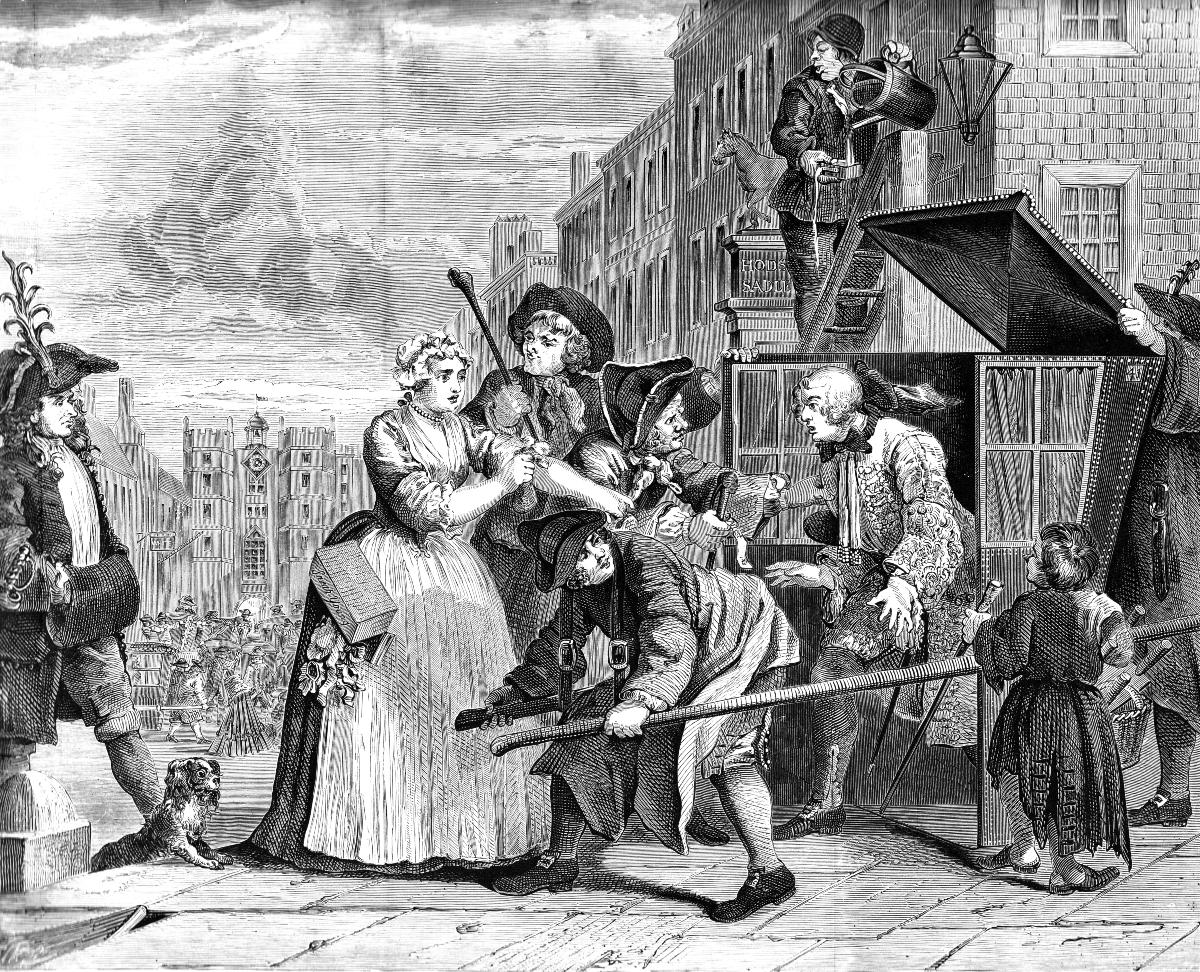
The Arrest for Debt (William Hogarth’s ‘A Rake’s Progress’ (1735). This is St. James Street on St. David’s day when crowds in carriages and sedan chairs are hurrying to St. James Palace for the celebrations. The man on the left of the engraving is a Welshman with a leek in his hat. Tom is being carried in his sedan chair but is rudely intercepted by bailiffs who arrest him for debt. Tom’s old sweetheart, Sarah Young, happens to be passing and saves the situation by paying what is necessary. Meanwhile an urchin robs him of his gold-headed cane and a man replenishing a street oil-lamp distractedly allows the oil to overflow onto Tom’s head.)
Tom was said to have dismissed scripture as “Ezra’s fables” and “a rapsodie of feigned and ill invented nonsense, patched up partly of poeticall fictions and extravagant chimeras”. He regarded Jesus and Moses as political “impostors” and said he preferred Mohammed. He called Biblical miracles “pranks” and said Jesus and Moses exploited a common training in Egyptian magic to manipulate the vivid imaginations of “ignorant blockish fisher fellows”. The Apostles were dismissed as a company of silly, witless fishermen and he wondered why the world was so long deluded with their contradictions and nonsense.
Such blasphemies saw Aikenhead hauled before the Privy Council on 10th November 1696 where they ordered he be put on trial for his life at the High Court of Justiciary, locking him up in the draughty eastern wing of Edinburgh’s tollbooth, a five-story building already three centuries old where his mother had been imprisoned.
Edinburgh’s tollbooth
Many of Tom’s classmates testified against him. The gang leader was 21-year-old Mungo Craig who hoped to be a minister and “heard him revile the books of the New Testament and call them the books of the impostor Jesus Christ”; Patrick Midletoune reported “that about the middle of August last, about eight o’clock at night, going by the Tron kirk, he hard him (being cold) say that he wished to be in the place Ezra called hell, to warm himself there” and John Neilson said Aikenhead thought of the contradictory nature of the Trinity as the same as a “squaire triangle”.
Aikenhead’s trial would be before Stewart of Goodtrees, the king’s advocate, Sir Patrick Hume, the king’s solicitor, Hume of Polwarth, the Chancellor and other senior judges. News of Aikenhead’s trial spread. Tom was not so well connected as John Fraser. Unlike many of those who condemned him, he had not invested in the infamous Darien scheme, an unsuccessful attempt by the Kingdom of Scotland to become a world trading nation by establishing a colony called ‘Caledonia’ on the Isthmus of Panama. Nor could he boast family links to covenanting Christians or any merchant or professional connection of note.
Lord Advocate, Sir James Stewart prosecuted 20-year-old Tom and demanded the death penalty to set an example to others who might otherwise express such opinions in the future. On December 24th 1696, the jury found Aikenhead guilty and he was sentenced to be hanged. Tom petitioned the Privy Council to consider his “deplorable circumstances and tender years”, but to no avail. The Privy Council ruled that they would not grant a reprieve unless the Kirk interceded for him. The Church of Scotland’s General Assembly, sitting in Edinburgh at the time, urged “vigorous execution” to curb “the abounding of impiety and profanity in this land”.
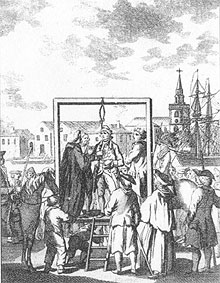
Leith gallows
On the 8th January 1697 Tom Aikenhead took the hour-long march to the gallows in Leith after reading a letter saying: “It is a principle innate and co-natural to every man to have an insatiable inclination to the truth and to seek for it as for hid treasure… So I proceeded until the more I thought thereon, the further I was from finding the verity I desired…”
Clutching a Bible, Tom tried to pray with a speech of “great disorder” before a hood was placed over his head and the ‘hempen necktie’ hung round his neck. Michael F Graham delivers the grisly details in his book The Blasphemies of Thomas Aikenhead: Boundaries of Belief on the Eve of the Enlightenment: “Those hanged rarely died instantly, so onlookers probably would have watched him shudder for several minutes as he twisted in the chilly January breeze and gathering darkness, fist clenched, nose and mouth oozing a bloody mucus, gradually suffocating. The moment of death was often marked by the appearance of stains as the victim’s bladder and bowels released their contents”.
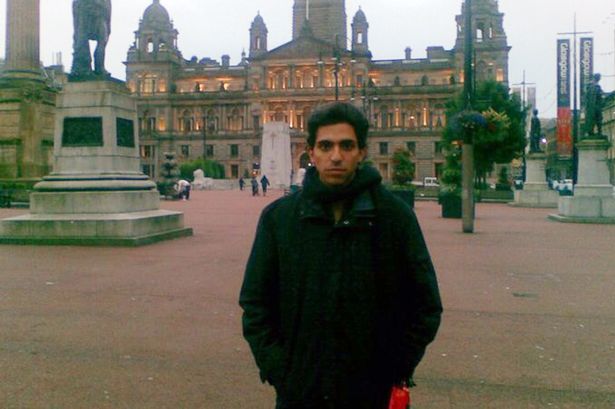
Raif Badawi in Glasgow
On the 8th January 2015, five days before his 30th birthday, Raif Badawi was awarded the Scottish Secular Society’s inaugural Aikenhead award while he was languishing in prison, convicted under Saudi Arabia’s Anti-Cybercrime Law, “founding a liberal website…, adopting liberal thought” and for “insulting Islam”. He was sentenced to 10 years in prison, 1,000 lashes and a fine of 1million Saudi riyals in Jeddah’s Criminal Court. Badawi’s lawyer, Waleed Abu Al-Khair, a human rights activist, was also arrested and sentenced to 15 years in jail for charges including “undermining the regime and officials”.
Raif received the first 50 lashes on the 9th of January after Friday prayers to the merciful Allah in a square outside a mosque in Jeddah watched by a crowd of several hundred who shouted Allahu Akbar (God is great) and clapped and whistled until after the flogging ended. The hospital advised Raif was too ill to receive the next 50 lashes scheduled for the following week. But in prison he remains.
Garry Otton 2015 (author of ‘Religious Fascism’)
‘The Blasphemies of Thomas Aikenhead: Boundaries of Belief on the Eve of the Enlightenment’ by Michael F Graham
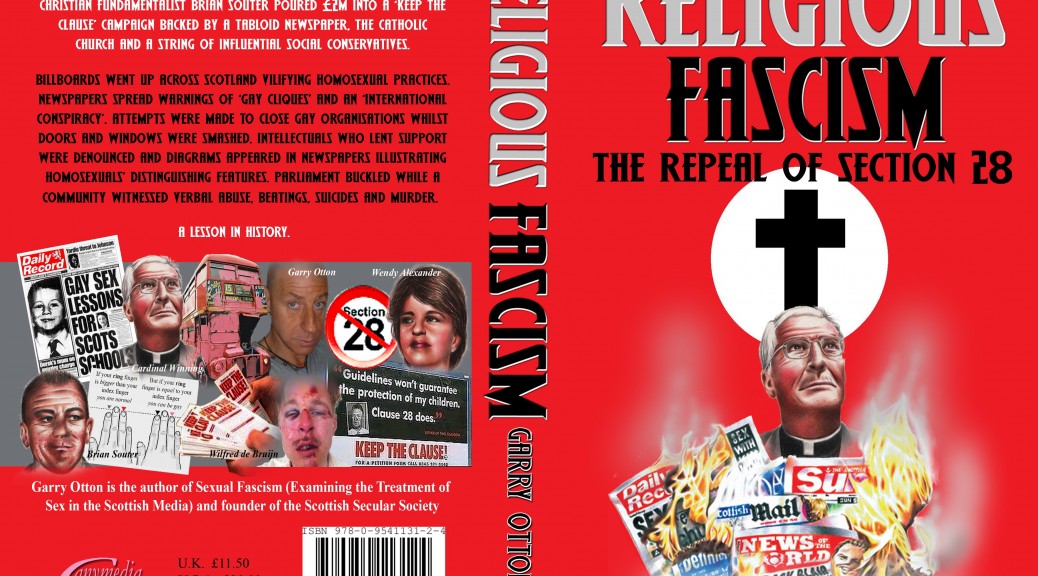
The repeal of Section 28 was a forerunner to later terrorist acts attributed to religious extremism. The religious-backed campaign terrorised a community and threatened Scotland’s fledgling parliament.
Some will see the imposition of Section 28 – the law that forbade the “promotion” of homosexuality as a “pretended family relationship” – against a backdrop of Margaret Thatcher addressing a sea of waving Union Jacks at the Conservative Party Conference of 1987 following hot on the heels of exaggerated tabloid stories of black lesbian self-defence groups or books like ‘Jenny Lives with Eric and Martin’ in school libraries. (It was actually in a teachers’ resources library). When this Tory, anti-gay, religiously-inspired law was challenged in 2000: Scotland would be the main battleground.
In England and Wales, efforts to keep Section 28 on the statute books was, to a large extent, pointless since Section 28 applied not to schools but local authorities whose control many had opted out of under measures introduced by – of all people – former Tory leader Margaret Thatcher.
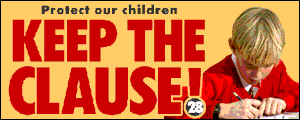
The Scots remember repeal as a time when the gay community was under attack from billboards mounted across every available space in Scotland vilifying homosexual practices. Intellectuals who wrote to newspapers to lend support were denounced. Newspapers spread warning of ‘cliques’ and rumours of an ‘international conspiracy’. Attempts were made to close LGBT organisations and doors and windows of such premises were smashed. Pictures could even be found in newspapers illustrating a homosexual’s distinguishing features. Parliament wavered and buckled while a community in crisis was left to defend itself against a rise in verbal abuse, beatings, suicides and murders. This wasn’t Germany in 1935: It was Scotland in 2000. It was sparked by MSP Wendy Alexander announcing the repeal of Section 28 and Christian fundamentalist Brian Souter pouring £2m into a ‘Keep the Clause’ campaign backed by Cardinal Winning of the Catholic Church and a string of influential social conservatives.
It began in 1999 when controversial American TV evangelist Pat Robertson, owner of a mammoth media, educational and legal empire in the USA with an estimated value of a billion dollars, was introduced to ultra-conservative Catholic Bill Hendry, the Bank of Scotland’s executive vice-president. The bank announced it was setting up a telebanking operation with Pat Robertson who once claimed that the “feminist agenda is not about equal rights for women: It is about a socialist, anti-family political movement that encourages women to leave their husbands, kill their children, practice witchcraft, destroy capitalism and become lesbians.” As Bank of Scotland share prices fell and clients started withdrawing their savings, the bank was forced to pull out. Robertson labelled Scotland a “dark place” over-run by homosexuals. The bank called on media boss and ex-Sun editor Jack Irvine to step in. During the equally contentious debate about an equal age of consent, Irvine was famous for referring to “pretty young boys of 16” who couldn’t vote being “mature enough to be bum chums for sleazy old pervs”. Scotland’s richest man, Stagecoach boss, Brian Souter, a Bank of Scotland customer and member of the hellfire and brimstone Church of Nazarene, was sufficiently inspired by Irvine to court him for an idea of his own. They shared a good lawyer. Jack Irvine’s business partner Peter Watson sometimes accompanied him on business trips to the Cayman Islands. He was the man behind legal firm Levy & McRae which legalled articles for the press. As Scotland’s top lawyer, Watson counted the Lord Advocate of Scotland, Elish Angionlini, an appointed member of the Scottish Government as one of his most prestigious clients.
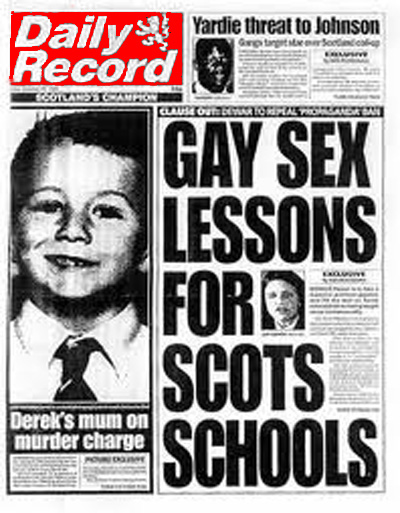
Powerful figures backed the ‘Keep the Clause’ campaign. Not just Martin Clarke, the editor of Scotland’s top-selling tabloid the Daily Record, but also the editor of the Sun, Scotland on Sunday, the Daily Mail, the Telegraph and numerous other publications. Given the surfeit of Christian journalists and columnists in the media and both the Westminster and Scottish Executive, there was no shortage of allies to respond to this emerging Christian campaign.
Keep the Clause
Under the auspices of preventing the repeal of Clause 28, gays were made scapegoats for a war against “the siren voices of liberalism”, secularism and permissiveness. Education packs that either sought to counter bullying by creating a better understanding of gay people or sex education leaflets aimed specifically at gay people to encourage safer sex were put under scrutiny. All the while the media perniciously portrayed homosexuals as a sinister menace with inferences of a “homosexual lobby” seeking to prey on impressionable youth and further a selfish agenda. Homosexuals were maligned in a media campaign furnished by well-funded Christian charities and organisations – some collecting around £2 million in annual income – like the Christian Institute and Christian Action Research and Education (CARE). Scotland’s fledgling Parliament would twist and turn as one compromise after another was offered to placate the pious.
Pleas for equal treatment were contorted into demands for additional rights. A victim of the Soho gay pub bombing was denied compensation under the Criminal Injuries Compensation after sustaining injuries and losing his partner whilst the partner of a heterosexual couple won theirs. And then, when Martin Fitzpatrick who fought successfully against eviction from a house he shared with his partner after he died, former religious correspondent and Daily Record columnist Tom Brown wrote: “What worries me is that this will be taken as capitulation to the homosexual cause. …The signal to demand more”.
SNP MP Jim Sillars, writing in the Scottish Sun sneered at “test tube births on a scale of millions, with the sperm of homosexuals conveyed artificially to women’s ovaries, in order to give homosexuals full rights to have children. That test tube world is the only logical conclusion of the Tatchellite campaign of full and equal rights”.
Scotland on Sunday Catholic columnist Gerald Warner wrote that “homofascism” was “aggressively and shamelessly, the ideology of the parliament”, that “homosexual missionaries” were coming for the children and incited people to take to the streets in protest. He mocked the lisp of Labour MSP Wendy Alexander, the “Minithter for Communitieth” who fronted the campaign for repeal before suggesting she was “living testimony to the unwisdom of abolishing the ducking-stool”.
Any equal treatment of gays was fair game. Gerald Warner’s homophobia knew no bounds. On gay partnerships he scoffed: “There is a vote-winner for you. Possibly with the co-operation of sympathetic local authorities, provision could be made for the romantically-minded to hold their wedding at the public convenience where the happy couple first met”. Special pages of letters in newspapers against repeal frothed with homophobia like this one from John McBride of Shettleston who wrote in the Scottish Sun: “I don’t have any kids myself but if I did and anyone tried to teach them about homosexuality I’d probably end up assaulting the teacher”.
In the Metro, owned by the same publisher as the Daily Mail, nine out of 10 letter-writers in the London edition were found to share the same names or initials as those in the Scottish edition even though what they wrote was completely unrelated.
Cardinal Winning was soon declaring gay sex a ‘perversion’ and, on a trip to Malta, compared the gay lobby’s imagined distribution of material in schools to Nazi bombs during the second world war. Upon his return he was met with press reports of a serious attack on a young doctor outside an Edinburgh gay bar. Threats of suicide to the gay switchboard doubled.
When a string of professors and academics wrote to the press sharing their concerns, they were mocked by the ‘Keep the Clause’ camp. Journalists regularly attacked Labour politicians who supported repeal. People like Donald Dewar’s adviser Philip Chalmers was caught with “a lady who was not his wife – although she may have been somebody else’s” in the back seat of his car in a red-light area after the Record were tipped off by police. Donald Dewar’s chief of staff John Rafferty was also targeted when he exaggerated death threats to health minister Susan Deacon over her support for abortion. But the chief target was always Wendy Alexander, described in the Record as “bossy”, a “spinster”, and “five-foot-nothing” and showered by a host of other uncharitable and misogynistic remarks. They suggested she was “riding high in the Department of Frump” and gave her a makeover, superimposing her head onto the body of a woman curled up on a couch wearing a white trouser-suit with lilac-strapped shoes. Alan Cochrane in Scottish editions of the Daily Telegraph called her the “accident-prone and politically myopic Miss Alexander”. Channel Four awarded Wendy Alexander a trophy and the title Parliamentarian of the Year in Scotland. The press were delighted to report how she smashed it to pieces as she got out of a car at Heathrow Airport. The following year, Channel Four awarded it to Christian homophobe Baroness Young!
Most of the press accepted paid advertising of ‘Keep the Clause’ petitions to complete and send to the Government. Many were backed by articles or even marked to indicate exactly where to sign to keep Section 28. Churches soon followed urging their congregations to sign. A free mailing address was set up to collect the thousands of signed petitions. The Scottish Sun found “condoms – sent by gay rights activists fighting to scrap Clause 28” whilst the Record reported the delivery of old beds and refrigerators.
The Daily Record’s editor Martin Clarke ran a long homophobic campaign to support Keep the Clause.
Brian Souter threatened to launch a private referendum. He castigated the Electoral Reform Society (ERS) for refusing to back it, so, using an old electoral register, he launched his own after accusing a ‘gay clique’ in the Labour administration of wrecking his plans. MP Jimmy Wray referred to a ‘gay mafia’ in the Scottish Sun and in the Scotsman he advised: “People didn’t vote Labour into power to allow the country to be run by a gay mafia. The public don’t want to know what homosexuals are doing. This is the trendy minority trying to dictate to the majority, and it won’t work”. Echoing the Nazi treatment of Jews in the thirties when there were references to powerful Jewish cliques influencing government and of Jewish trickery, the Scottish Sun referred to “gay dirty tricks”. The Record warned: “The Section 28 turmoil has gone from unsatisfactory to downright sinister. It is now clear that powerful factions are determined that the people of Scotland will not have their say”. This was also aimed at ERS member and gay Labour MP Stephen Twigg, The ERS were in fact concerned about the rise in violence toward gays being reported by the police. ‘Keep the Clause’ had already become a playground catchphrase and police set up a special surgery in Edinburgh.
The Daily Mail printed a double-page spread with an anatomical diagram of the human phalanges explaining: “Homosexual men have slightly shorter second fingers than straight men”. The Record also carried the information along with their homophobic content.
In a film review for American Beauty, the Daily Mail detailed how Hollywood was “demonising heterosexual life as part of a disturbing new pro-gay agenda… This held that heterosexuality was a curse to be denigrated and mocked wherever possible and that gays could never win the power they craved in society without undermining heterosexuals whenever possible”.
Three quarters of those surveyed by the Gay Police Association cited ‘belief of perpetrator’ as a prime motivator behind homophobic incidents. Their advertisement showing a Bible and a pool of blood with the words: “In the name of the Father” was censored by Advertising Standards Authority. Despite coming eighth in a list of campaigns receiving the most complaints, ‘Keep the Clause’ posters were never removed despite widespread defacements from protesters.
Outcast, a gay political website, was closed, according to the Internet Service Provider (ISP), “following a complaint”. A university lecturer was paid almost a quarter of a million pounds in damages and legal costs by the ISP Demon, owned by Scottish Telecom, in an out-of-court settlement over material carried on the site. Outcast was a respected and nationally distributed gay political magazine run by volunteers with a circulation of around 10,000. It boasted contributions from many people who were sympathetic to gay equality, The ISP NetBenefit wanted an assurance from a solicitor acting for Outcast that they would not print anything libellous. “Obviously, no solicitor can give a guarantee like that”, said editor Chris Morris who had previously taken Britain to the European court over its unequal age of consent law.
A Christian couple, backed by Christian legal representatives, sought to take Glasgow City Council to court for “promoting” homosexuality. They eventually withdrew but succeeded in persuading the Council to write to all council-funded LGBT groups warning them not to “promote” homosexuality. The media spun it as a victory.
As the campaign to repeal went nationwide there was a surge of violence and murders, particularly gay men, across the whole country like 50-year-old Alex Noble who met his fate after picking up an 18-year-old in Glasgow. Ethan, a sensitive 16-year-old who was being bullied in a Catholic comprehensive in the Highlands hung himself.
The fledgling Parliament shook and wobbled at every turn towards repeal. At first, Ministers said that the guidelines on sex education were adequate and would not be reviewed: then they were. Despite insisting there would be no replacement clause for Section 28: the Scottish Executive was soon tabling one. Ministers insisted the guidelines on sex education would not be made legally binding: then came a U-turn. The public were assured by Donald Dewar that there would be no inclusion of marriage in any guidelines, but with an amendment by Catholic MSP Michael McMahon, religious campaigners were soon trying their luck with that too.
That was nothing compared to the semantic contortions Scotland went through over sex education. Without a national curriculum as in England and Wales, Scotland had no need for statutory guidelines. There were no calls from teachers for statutory guidance on drugs or alcohol where teachers were trusted. Now there were calls for statutory guidelines on sex education. Minister for Children and Education Sam Galbraith emphasised that these were not ‘guidelines’, which would govern the contents of statutory legislation – always rebuffed as contrary to Scottish practice – but ‘guidance’ which govern the conduct of sex education in Scotland. The ‘guidance’ was to state that parents had to be consulted if sex education – appropriate to pupils’ ages – were given to their children and that they could even remove them from classes, (although such a right already existed).
Section 28 was eventually repealed and stories of schools invaded by ‘homosexual propaganda’ proved entirely false. The same couldn’t be said for religion which, if it didn’t already own the school, had their unelected representatives on all of Scotland’s education committees. If schoolchildren couldn’t be rounded up to visit churches, clerics were invited into the classroom to work with children in so-called non-denominational schools without parent’s knowledge, which happened at Kirktonholme Primary School in East Kilbride where extreme sect Church of Christ had been pushing creationist anti-science literature on children for eight years before they were rumbled and exposed in the Daily Record, albeit it under a new editor.
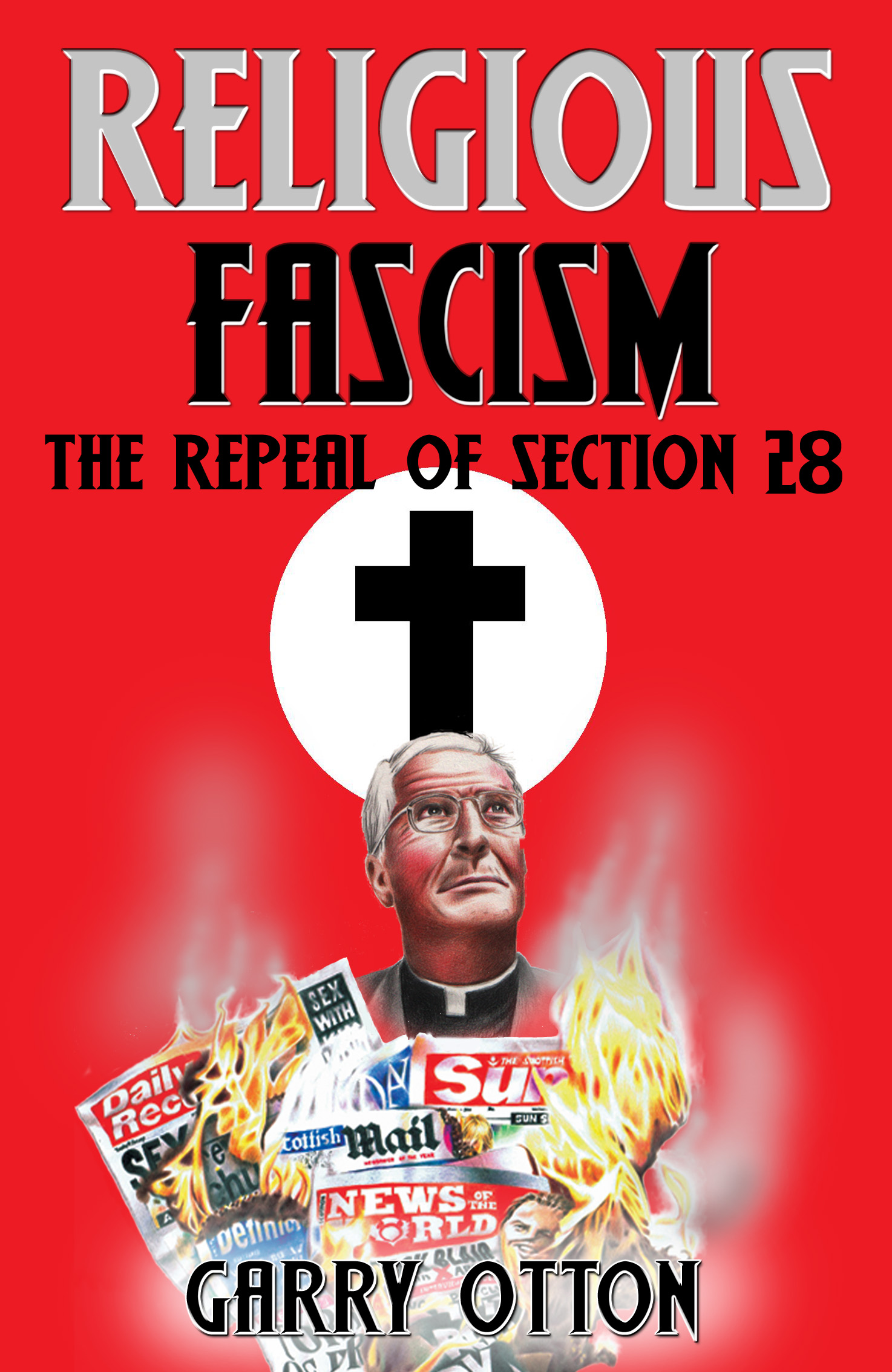
Garry Otton’s Religious Fascism (The Repeal of Section 28) is published by Ganymedia.
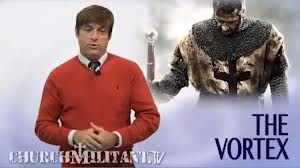
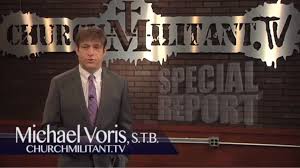
Less than a week after inviting a controversial abstinence-only preacher from the US to speak to schoolchildren in Paisley, the Catholic Church once again demonstrated a shameful lurch to the extremist right. Church Militant TV presenter, Michael Voris was invited to talk to a packed hall of Catholics aged mostly sixty-plus with twenty-or-so hard-core young Catholic evangelists from Stirling, Dundee University, Glasgow, Hamilton and various other Catholic churches along with the Catholic Parliamentary Media Officer, John Deighan for a meeting in Motherwell, across the road from the Carfin Grotto.
In typical Bible-belt fashion, Voris is a suit and tie, tanned, toupee-wearing, Catholic apologist from Texas who dismisses global warming as “pseudoscience and hyper-sensationalism”. He correlates Hitler’s eugenics programs to global warming, theories of overpopulation, and support of contraception and legalized abortion, saying “What you have to understand is that the elite have now moved on to a sort of new updated version of this, a new technique. It’s not eugenics anymore. Now it’s called global warming.” He worries that many Catholic clerical hierarchy are “namby-pamby” and says he feels that what is needed now is “muscular Catholicism that isn’t afraid to encourage battle and sacrifice.”
Now he is delivering his militant message to an audience of around 150, asking them to put their hands up if they know two souls who had left the Catholic Church? There was a sea of waving arms as at least two-thirds signalled the loss. He claimed his “only conclusion” was that “Catholic leaders had lost faith.” That, and the spate of disgraced priests, bishops (and a cardinal, although he did not once refer to Keith O’Brien, except to point to the “social ill” of homosexuality) who were carrying away with them lost souls. The Catholic Church was “falling apart,” he admitted.
Catholic blogger, Michael Voris
Voris has had much to say about “militant gays” who “violently promote the gay agenda of free disordered sexual behaviour, redefining marriage into extinction and aggressively wearing down those who don’t approve of the gay lifestyle”. Yet, in 2016 he admitted to engaging in “sins of a sexual nature” with other men and claimed the New York archdiocese was planning to exploit his “past life” and use it against him. He said: “For most of my years in my thirties, confused about my own sexuality, I lived a life of live-in relationships with homosexual men.
“From the outside, I lived the lifestyle and contributed to scandal in addition to the sexual sins. On the inside, I was deeply conflicted about all of it. In a large portion of my twenties, I also had frequent sexual liaisons with both adult men and adult women.”
He added: “These are the sins of my past life in this area which are all now publicly admitted and owned by me. That was before my reversion to the Faith.
“Since my reversion, I abhor all these sins, especially in the world of the many, many other sins I have committed having nothing to do with sexuality.
“I gave in to deep pains from my youth by seeking solace in lust, and in the process, surrendered my masculinity.
“Many of you know the story of my mother’s prayers and sacrifices and pleading to God on my behalf that I give up my sinful life and return home to the Church.
“As a last resort, she prayed to be given whatever suffering needed so that I would be granted sufficient grace to revert. It was shortly after that prayer that her very early stage stomach cancer was detected, which she died from a few years later.
“When my mom died, I pledged at her coffin that I would change… I returned fully and completely to the Faith.”
In Motherwell, Michael Voris advised “the Devil never takes a vacation, some don’t have bodies and they don’t need to rest.” The state of the Catholic Church, he surmised, was a result of “an attack by the diabolical”. There were nods and shuffles, but little sign of dissent. The audience had been well trained in obedience. He dipped into the Old Testament for evidence and to recount how “the snake just goes up to Eve and proposes a question – all is easy, isn’t it – she engages with him…” A moment’s pause before shouting. “BUT WE SHOULDN’T ENGAGE WITH THE DEVIL AT ALL!”
After prayers, first from a local cleric and then Voris, he confirms: “We have such an intense relationship for Him we would die for Him.” And that pretty much confirms his somewhat militant response to the collapse of the Catholic Church. “The job of the Church is not to make soup kitchens,” he scoffs, “but to make Saints.” He reminds the faithful of something they probably already know: “The Catholic Church isn’t about feelings.”
The Church’s position was quickly escalated. “The Catholic Church is the only thing that has been invested with the light of God”, he declared. The Church of Scotland and England, along with Jehovah’s Witnesses were dismissed as “man-made institutions.” And if you ever wondered how lonely a place Heaven might be, he ranted: “There is no-one in Heaven; except for Catholics,” adding, that if a few from other religions “found their way there it was despite of another faith; not because of it.”
He charged his audience not to seek popularity and to speak the Truth, (and only the Catholic Truth), so when they spoke to friends at work, their colleagues were really hearing Jesus. “And it will be offensive,” he warned. But this wasn’t an option,” the unmarried Michael Voris added: “It was a command…
“We need to explain why contraception and same-sex marriage is evil.”
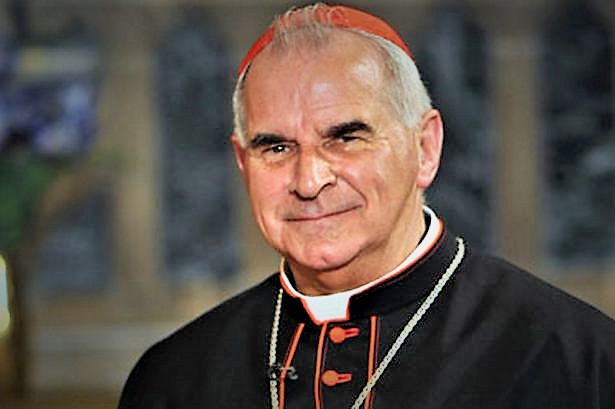
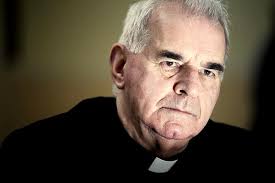
If pride comes before a fall, it was a very big one for Cardinal Keith O’Brien and the Catholic Church when the Cardinal got caught with his pants down…
Well, well, well! What a year 2013 was! If there’d been a gay god in Heaven, she’d have thrown a party and we would all have been invited! First Herr Ratzinger suddenly resigned after some wag found a ‘gay mafia’ within the walls of the Vatican, then Mr O’Brien gets caught with his hands down his priests’ cassocks. Never mind Stonewall’s Bigot of the Year award, perhaps we could have just had the names of these seminarians to hand out some big silver goblet at an Oscar ceremony for services to the gay community.
I know. I should have had more sympathy for Keith Michael Patrick O’Brien, born into a socially conservative Catholic family in Ireland in 1938 and indoctrinated in a sectarian or so-called ‘faith’ school with all its twisted logic on sex and homosexuality. The Scotsman reported him reassuring everyone: “I accept and promise to defend the ecclesiastical teaching about the immorality of the homosexual act…” You could almost picture him licking his pinkie and flicking over a gilt-edged page of Leviticus. But it all went pear-shaped from there really… Young men boarding in a 19th century baronial mansion at Drygrange, drunken parties, crushes on young ‘pups’, japes in the ‘jakes’ (communal bathrooms) and then lights out in the dorms after a ‘rager’ (wild party). Firstly, the Cardinal, irritable at not knowing what priests had blabbed, scorned them, (so many men…?), accusing them of vagueness before delivering his own mealy-mouthed apology vaguer than an apparition of Mary Magdalene. It was brief. He was forced to suffer the terrible ignominy of admitting: “I’ve fallen below the standards expected of me as a priest, archbishop and cardinal”. Indeed. All these lads were over 18! But the world wasn’t interested in his man-on-lad fun. The world’s press were honing in on his Ted Haggard moment so we could gasp at his naked hypocrisy! Oh, look…! The Cardinal has no clothes! He added: “In recent days certain allegations which have been made against me have become public. Initially, their anonymous and non-specific nature led me to contest them,” he protested too much, before adding: “To those I have offended, I apologise and ask forgiveness. To the Catholic Church and people of Scotland, I also apologise.” The gay community he’d made his mission to kick shit out of were presumably bundled in with the ‘people of Scotland’ before he shot out the door with his bags and fled the country to enjoy his retirement. (Or to live his life as a hermit if you were to believe the Catholic Church).
So there I was, practically dancing naked on the tables in celebration. It was only when I was joined by other religious Catholics did I start to become decidedly uneasy. Daily Telegraph Catholic apologist, Damian Thompson was agreeing with those calling the Church “complacent”, “sclerotic”, “arrogant” and “philistine”. I had to check the newspaper’s header. Eddie Barnes, a former Catholic newspaper editor and one of many Catholic contributors to The Scotsman called the Church “fallen”. Archbishop Tartaglia grimly warned from the pulpit the church had had its “credibility undermined” and was “damaged by hypocrisy”. There came a point when even the BBC confessed the Catholic Church didn’t have anyone in Scotland that could comment on stories.
Those left standing looked decidedly ridiculous. A Catholic woman on Call Kaye’s BBC Scotland phone-in was frothing at the mouth over a “gay agenda”. Reporters attending a Mass found members of the congregation dismissing allegations as “lies”. The bad-tempered Peter Kearney of the Scottish Catholic Media Office – normally always up for a fight – was nowhere to be seen. First Minister, Alex Salmond, who had publicly backed Cardinal O’Brien, opened the doors to Bute House after his election and spoiled him with private meetings over equal marriage (the Equality Network had none), was determined not to be distracted by the cleric’s downfall after all the good things he’d done. Justice Secretary Kenny MacAskill who must’ve been listening to Steps in the car called it a “tragedy”.
The Scottish Catholic Media Office looked sadly desperate as they attempted to pick up the pieces. A front page ‘exclusive’ by Joe McGuire in The Glaswegian was defiant: “CITY KEEPS THE FAITH” and “Church scandal ‘will pass’”. Archbishop Tart’s spokesman begged the congregation “not to throw in the towel” and, in a perkier note, added: “All the reports we have suggest that people are continuing to attend church as normal – we certainly haven’t registered a drop on attendance”. That was not confirmed by other reports; one finding Mass numbers down by a half. One almost felt sorry for Peter Kearney, who, only weeks ago, was pictured happily languishing across a sofa in beige.
There was nothing left to do but for the press to give a brief but passing mention to what fun it was having Keith in the house before looking back on his best bits.
One section of the community had borne the brunt of Cardinal Keith’s best moments. Every nasty attack backed by the Vatican, amplified by the Scottish Catholic Media Office and their media cronies were engraved on his headstone. Like when he wrote in the Sunday Telegraph that same-sex marriage was “grotesque”, a form of “madness” and “like bringing back slavery”. The Vatican wing of the BBC had treated it as ‘breaking news’, headlining the story with feigned surprise that he should be the “latest” of several senior clergy they’d been lining up to bad-mouth same-sex marriage.
O’Brien was reported saying gays were ‘captives’ of ‘sexual aberrations’. He bragged about his deep pockets too. In the Sunday Times Scotland, he warned the Scottish Government that it could expect an “unprecedented backlash” from his Church if it let gays marry, claiming “marriage is under threat and politicians need to know the Catholic Church will bear any burden and meet any cost in its defence.” He promised the Catholic Church would spend an additional £100,000 on an advertising campaign against the plans, on top of the £50,000 it had already spent.
Prior to Ratzinger’s ‘state’ visit to Scotland – which was at considerable cost to taxpayers, involving the raiding of funds set aside for overseas aid and coinciding with news of 13 suicides of former victims of priestly abuse in Belgium – The Scotsman printed issue after issue of coverage with fawning deference to the Catholic Church, including a double-page spread with several photos of Cardinal Keith O’Brien laughing; smiling and saying that he would be “happy” if the Pope didn’t apologise for child abuse, adding that there wasn’t very much in Scotland anyway. Oh no? With demonstrable indifference to the head of the BBC Trust, Tory Lord Patten, who took personal charge of the Papal visit, a renegade journo at the BBC discovered bishops in the Catholic Church in Scotland weren’t always passing cases of child abuse to the police and reported at least 20 allegations of child sex abuse by priests between 1985 and 1995.
Was Cardinal Keith O’Brien reminiscing with any fondness to a time when the Catholic Church supported Catholic sexual repression and hypocrisy? A time when, in 1994, Father Tom Connelly, skirting almost every story on morality in the Scottish press on behalf of the Scottish Catholic Media Office, and Cardinal Winning both advised that child sex-abuse cases shouldn’t be reported to the police – that it was the victim’s job! When in 2003, another Catholic columnist, Dani Garavelli could gleefully write in Scotland on Sunday: “O’Brien’s mild manner and open-mindedness on issues such as gay and married clergy have made him a popular figure both in and out of religious circles. His famous New Year soirees are attended by an eclectic group of people – MPs and cabinet ministers, journalists, priests and judges – all of whom turn up as much to enjoy his company as to network”. O’Brien wasted no time saying how offended he was by accusations he was a ‘liberal’.
With Vatican sympathisers at the very top of our State Broadcaster, Cardinal Keith O’Brien could be sure that any of the institution’s lies and obfuscations would be served to every household in Scotland on a gilded plate. The BBC became an institution like the Vatican where pious Catholics like Jimmy Savile abused with impunity. But it is that vaulted position that set O’Brien apart from all the other old fools to make the backlash of criticism so necessary. So very legitimate. A hypocrisy that had to not only be exposed; but publicly reviled. Hypocrisy can indeed be the denial of some indiscrete fumblings. It can also be Nazis burning books and records containing details of their own indiscretions before incarcerating others for what they’ve done themselves. Hypocrisy doesn’t just manifest as bullying; it can become state-endorsed persecution.
It takes just one guilt-laden, confused, drunken, excited sexual encounter, wrapped in religious dogma and cant, to later manifest itself into horrible atrocities. That is what I see behind the Greek Orthodox Church building brutal alliances with Greek neo-Nazi Party, Golden Dawn, physically assaulting playgoers outside Terence McNally’s Corpus Christi play in Athens. Or when Christian Orthodox members chant and wave religious icons as they invade a gay film showing in Bucharest screaming ‘death to gays’ with right-wing militants while police stand by and do nothing. Or when police sanction violent gangs allied to the Russian Orthodox Church to attack protesters of new laws outlawing gay equality. Then, as the virus spreads amongst its sexually dysphoric hosts, I see the BNP’s Nick Griffen take his seat in an hour-long debate on Christian TV. And I see The Sun, owned by a patron of much Vatican funding, Rupert Murdoch, engaging in talks with UKIP, virtually the only Party left promising Christians untold religious privileges if they win.
As Niemöller might’ve said if he hadn’t been a former Nazi sympathising conservative Christian: First they came for the homosexuals.
The question mattered intensely when war memorials were built, and in a changing political climate where symbols are increasingly used to promote ideologies, it should matter now.
When Glasgow’s George Square opens again, enjoying a glass of wine from one of the bars surrounding the golden Christian cross on Glasgow’s Cenotaph, might invite the complex notes of full-bodied Christian nationalism, a mid-palate of Orange Walks and a lingering finish of Christian Crusades.
Garry Otton
AI image
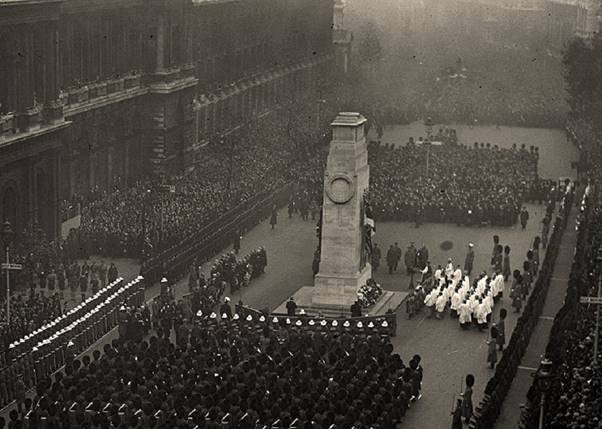
After the First World War, a makeshift memorial of wood and plaster with a coffin on top served as the original Cenotaph in Whitehall. It was buried in millions of flowers and wreaths before Prime Minister Lloyd George ordered something more permanent from the most famous British architect of the time, Edwin Lutyens.
Before the Great War, many churches and cathedrals housed memorials to wealthy commanders and officers who had fallen in combat, but it was almost unique to create a monument for common soldiers and sailors who had died far from home. Memorials for the Crimean War (1853 – 6) in St James’s in London and the Second Boer War (1899 – 1902) in Glasgow’s Kelvingrove Park, broke new ground. And, lest we forget: despite most memorials featuring Christian crosses, many who gave their lives were not Christian.
Like Prime Minister Lloyd George who insisted on the absence of religious symbolism, Edwin Lutyens wanted a secular memorial that honoured victims “irrespective of creed or caste” and argued with church leaders who were demanding to see a cross. He objected to “the inherent cruelty of the forced Cross” in the face of the diverse Indian, African, Jewish, and Muslim soldiers of the British Empire who also died in the war. He called his memorial a ‘Cenotaph,’ an Ancient Greek word that pre-dated Christianity describing an empty tomb of a missing warrior. The word was all but extinct in English until Lutyens revived it.
The Cenotaph in Whitehall, London, 1920, designed by Sir Edwin Lutyens.
In designing the Cenotaph, Sir Edwin Lutyens was heavily influenced by his wife. Lady Emily had a passion for theosophy and pantheism which deeply influenced the mystical, non-denominational dimensions of London’s Cenotaph. The outcome was a monument that visualised equality and diversity among those who fought and died and prioritised universal truth and brotherhood over Christian dogma.
Lady Emily was a member of the Moral Education League, opposed sex work and visited ‘lock hospitals’ to assist women who had been forcibly imprisoned with sexually transmitted diseases. Though she championed women’s suffrage alongside her militant sister, Constance, Emily rejected the movement’s growing militancy and opposed the presence of lesbians in the suffragette movement. Furthermore, she aggressively supported Indian independence at the exact moment her husband was designing New Delhi as a crown jewel of British imperialism. Her most enduring legacy began in 1911 when her friend Annie Besant brought the young Jiddu Krishnamurti to England to be groomed as the Theosophical movement’s celibate ‘World Teacher’ or ‘Chosen One.’ Emily became his surrogate mother and most devoted follower, touring the world with him through the 1920s in the belief that he was the new Messiah. Krishnamurti eventually broke away from the cult in 1929, famously declaring that “truth is a pathless land.” Behind his public persona of a celibate guru, over many years, he engaged in a secret romantic affair with Rosalind Rajagopal – the wife of his business manager. There followed a series of bitter lawsuits with his manager over the foundation’s property and intellectual copyrights that wasn’t settled until 1986.
After the First World War, the Cenotaph in London served as a mass grief site, with flowers, wreaths, and public participation lasting for many months. There had been up to 750,000 UK deaths (excluding Ireland) and over one million from the Empire. 2 million had been wounded in the UK with 40,000 amputees and 77,000 with severe facial disfigurements and blindness. Indian forces lost 72,000 personnel, Australian 62,000, Canadian 60,000 and New Zealand 18,000. 204,650 bodies were moved to cemeteries between 1918-1921. Many bodies were unidentified. So many friends and families had no grave to lay flowers.
The 1919 Peace Parade and Armistice Day ceremonies involved troop formations, salutes, wreath-laying, and a two-minute silence.
Processions and ceremonies drew large crowds, with estimates of over a million passing the Cenotaph and 500,000 entering Westminster Abbey over several days. Over 100,000 wreaths were laid, reaching ten feet high.
Men developed the custom of doffing hats as they passed the Cenotaph, but it was a practice that faded in the 1930s.
But there was still one section of the establishment that was not happy with Lutyens’s Cenotaph, reflecting the diversity of those who sacrificed their lives with the simple words ‘The Glorious Dead’ written across the Portland stone. In 1920, the Church of England tried to lead a backlash, bemoaning the absence of Christian inscriptions, crosses and prayers. The Catholic Herald called it a “pagan monument” unfit for a Christian country.
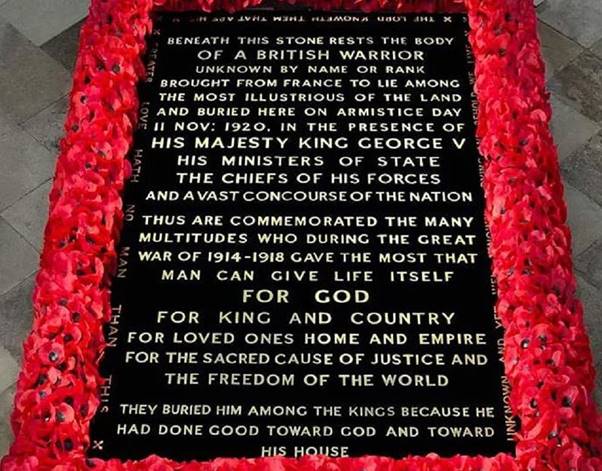
Prime Minister David Lloyd George and the government also rejected the idea of a tomb for an unknown warrior, favouring a secular, imperial symbol, but, supported by the Dean of Westminster, Herbert Ryle and King George V, the Church won the day, placing a tomb in Westminster Abbey. Despite protests, the inscription on the tomb was Christian, with the phrase: ‘In Christ shall all be made alive’ and: ‘They buried him among the kings, because he had done good toward God and toward his house.’ The main text made it clear who this poor man of unknown faith gave his life for with the largest space left: ‘FOR GOD.’
Tomb of the Unknown Soldier in Westminster Abbey, London.
The annual ‘Remembrance Sunday’ ceremony at the Cenotaph, from its unveiling in 1920, included Christian rituals led by bishops with prayers and mentions of Jesus Christ. Representations from other faiths were forbidden.
Between 1921 and 1923 the public rebelled against official remembrance ceremonies being held in Westminster Abbey. Working-class communities and veteran groups viewed the highly formal, state-funded ceremonies led by the Church and political elites, high-ranking military officials and royalty an extravagant distraction from the misery of the living. The slogan ‘Honour the dead – remember the living’ became a popular rallying cry. In a famous 1922 protest organized by the National Unemployed Workers’ Movement, an estimated 25,000 unemployed veterans marched on the Cenotaph and Westminster Abbey. Instead of wearing their military medals, they pinned pawn tickets to their coats to show they had been forced to pawn their bravery awards just to buy food.
The two-minutes silence on the 11th day of the 11th hour of the 11th month, when the Armistice Day ended the First World War, remains without priests, prayers, or mandatory religious dogma. As for the ceremonies at the Cenotaph in London, not until 2000 were other faiths included in the memorial service and not until 2018 could someone of no faith – a Humanist – formerly attend.
With such a catastrophic loss of life during the First World War, the public began turning its attention away from Christianity to embrace new beliefs like Spiritualism which gained massive support from the bereaved. In 1928 the Albert Hall was filled for a service which included mass communication with the dead. Other beliefs that were also gaining prominence at the time included Theosophy (a blend of western occultism and Eastern religious ideas,) Buddhism, Hinduism and Mohammedanism (Islam). The latter changed its name when it became clear how the title was as offensive as calling Christianity ‘Jesusism.’
Jealously guarding its exclusive rights to spiritual truth, the Church of England viewed these mystical and eastern influences as rival doctrines. Although many churches have embraced more liberal values, in the face of decades of decline in Christian belief, various Christian cults and branches have instead become more orthodox, retrenched, political and sometimes vociferous.
Efforts to move remembrance services from the Cenotaph to a more Christian setting at Westminster Abbey faced resistance in the 1920s as the church was seen as part of the establishment. In 1921 the government responded by swapping the choir singing hymns at the Cenotaph with a military band.
Attempts to be more inclusive in 1968, the ceremony’s fiftieth anniversary, saw a backlash from the Anglican Evangelical Alliance, but despite such resistance, a more multi-faith approach emerged over time.
That tension between secular mourning and religious ownership wasn’t confined to Whitehall. It travelled into local memorials and to Scotland where civic pride, imperial loyalty, Protestant and Catholic symbolism and public grief were compressed into stone, bronze and regimented ceremony.
Thankfully, in more recent times, there has emerged gentler reminders of lives lost in war, and ones that better chime with the veterans, families and friends who wanted the church and authorities to focus more on the living. Perhaps we can look at a few of these war memorials before we move on…
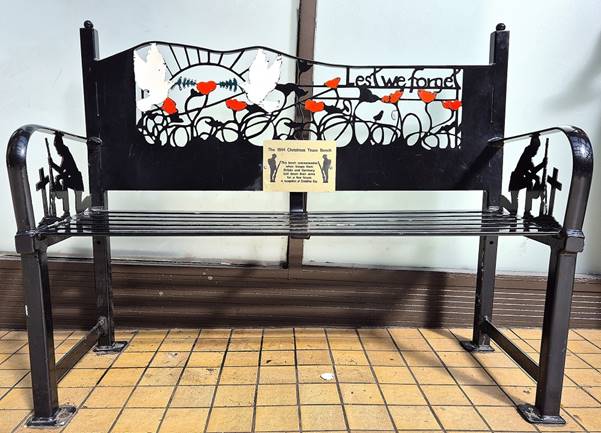
Beginning with one of the more useful, tucked away in Glasgow’s Central Station, there’s a beautiful wrought-iron, sculpted bench laced with poppies commemorating troops from Britain and Germany who laid down their arms for a few hours in recognition of Christmas Day. The Christmas Tree Bench serves as a perfect reminder of those who gave their lives in the First World War. Quiet and unassuming. A relief for tired feet, a moment to rest and reflect. Never demanding of attention. But always there.
The 1914 Christmas Tree Bench in Glasgow Central Station commemorating when troops from Britain and Germany laid down their arms for a few hours in recognition of Christmas Day. (Photo: Garry Otton.)
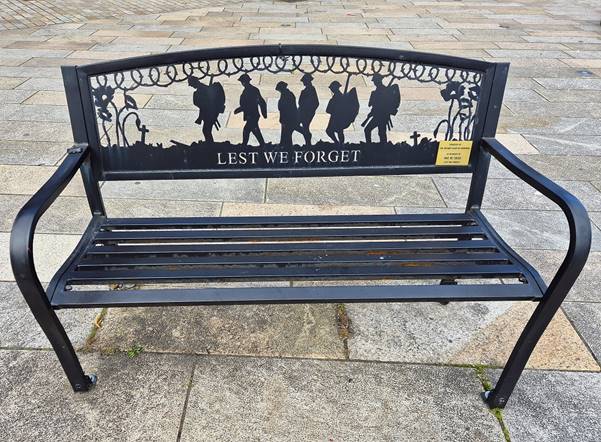
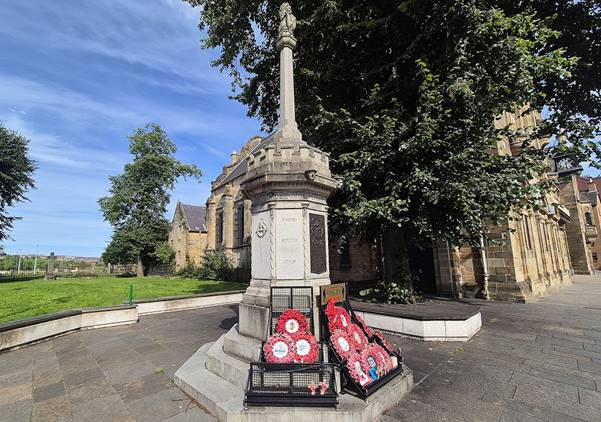
There is another memorial bench in the centre of Renfrew installed by Renfrew’s Rotary Club next to the town’s mercat cross-style war memorial.
Remembrance bench provided by the Rotary Club of Renfrew and installed beside the town’s war memorial. (Photo: Garry Otton.)
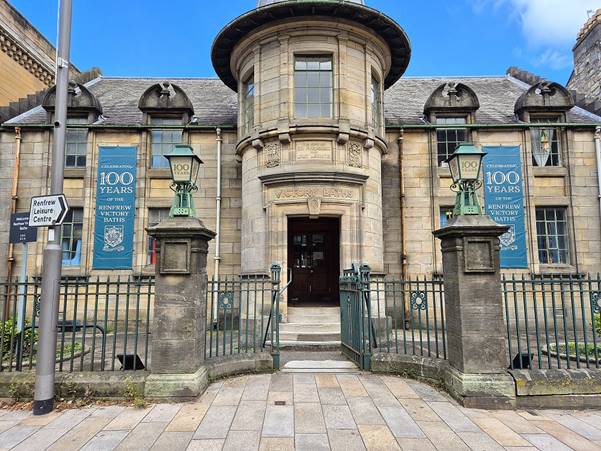
Another example of a useful memorial is the Renfrew Victory Baths. These Edwardian swimming baths were gifted to the Royal Burgh of Renfrew in 1921 by prominent local shipbuilder Sir Fred Lobnitz and his wife as a practical gift that actively benefited the health and daily lives of local families and future generations, rather than just a static monument. The building remains a functional public swimming pool and houses a commemorative wooden panel listing local soldiers who made the ultimate sacrifice.
The Renfrew Victory Baths. (Photo: Garry Otton.)
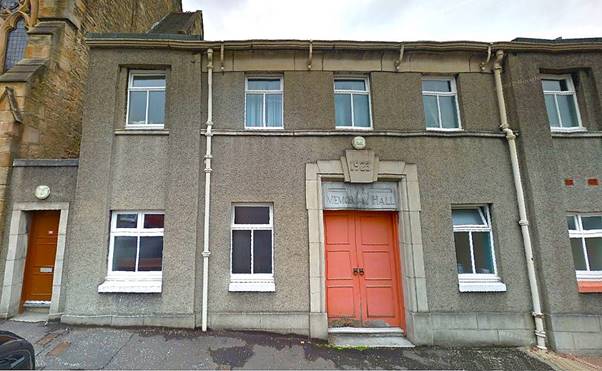
Serving as a community church space is the Mount Florida Parish Church War Memorial Hall. This Church of Scotland property was later sold to the Church of Pentecost Scotland, an anti-LGBT+ church that believes in tithing, divine healing and speaking in tongues. Ironically, the forefathers of the largely black congregation would have themselves been victims of the British Empire missionaries exporting Christianity to an Africa that had traditionally embraced none-traditional expressions of sexuality from those recorded in pre-historic cave drawings to later kings and queens. (King Mwanga II, monarch of the Baganda people in Uganda, was known for his sexual relations with his male subjects and a warrior woman from Ndongo kingdom of the Mbundu, dressed as a man and surrounded by a harem of men dressed as women, ruled as a king.)
Mount Florida Parish Church War Memorial Hall, Glasgow. Closed as a Church of Scotland congregation in 2010 and sold to The Church of Pentecost.
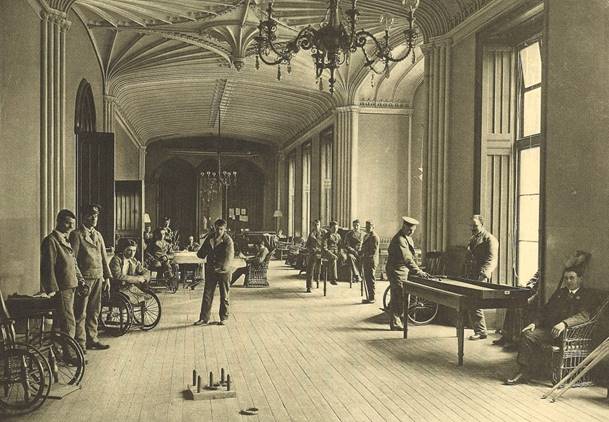
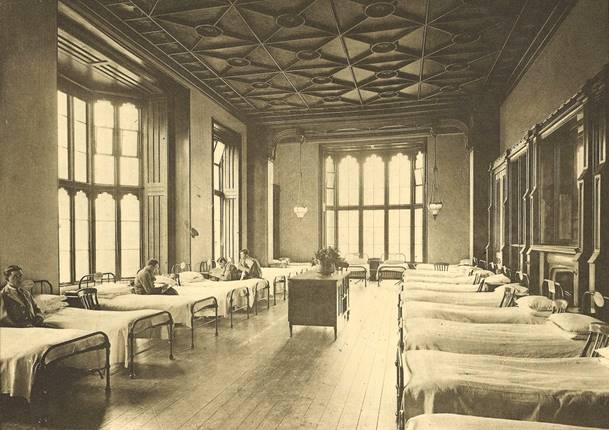
The Princess Louise Scottish Hospital for Limbless Sailors and Soldiers, (later Erskine Hospital and now the Erskine Veterans Charity,) was also a Scottish war memorial that reminded us of the lives sacrificed whilst serving a very essential purpose for the living.
The Recreation Hall of The Princess Louise Scottish Hospital for Limbless Sailors and Soldiers. (Photo: University of Glasgow Library.)
Ward 2, (formerly the Library), of The Princess Louise Scottish Hospital for Limbless Sailors and Soldiers. (Photo: University of Glasgow Library.)
Marble war memorial plaques housed in the former Church of Scotland parish church in the village of Burghead in the West Moray Presbytery were not so lucky. The church was converted into a Scotmid supermarket, and they had to be moved to an alternative site.
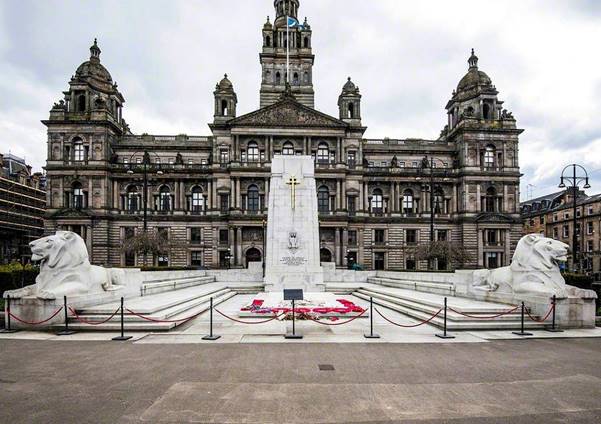
Less functional but the most famous of Scotland’s war memorials is Glasgow’s Cenotaph. It is an imposing structure that blocks your view of the opulent, granite, Beaux-Arts City Chambers in George Square like a concrete support in a parking lot! It drew much criticism when it was built in 1924. Several pre-existing historic monuments dedicated to Queen Victoria, Prince Albert, and William Gladstone had to be shuffled around, evoking the ire of traditionalists who thought the local council were vandalising the square. Letters to the Glasgow Herald lamented that the monument would block the majestic frontage of the city’s finest civic building.
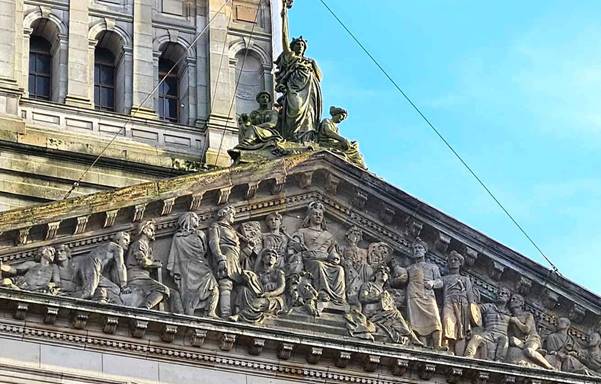
The building behind the Cenotaph, Glasgow’s City Chambers, was meant to reflect Glasgow’s status as the ‘Second City of the Empire’ with a triangular stone pediment celebrating Queen Victoria’s Jubilee. When she opened the building in 1888, the facade depicted her enthroned at the centre, flanked by allegorical figures of the UK home nations – Scotland, England, Wales, and Ireland – while representations of global colonial subjects occupied the outer edges bringing gifts and paying homage. Britain’s mission was to educate and ‘civilise’ the Empire with the aid of Christian missions like the Church Mission Society (CMS) and Society for the Propagation of the Gospel (SPG.)
Glasgow City Chambers. The triangular stone pediment celebrating Queen Victoria’s Golden Jubilee in 1887.
In a political landscape muddied by a complex web of personal rivalries and family alliances among her royal descendants, Queen Victoria looked down on Glasgow’s George Square where, in 1914, volunteers queued to enlist before being sent to the Front. Around 200,000 Glaswegians served in the First World War with approximately 182,000 returning home, many with catastrophic injuries or psychological damage to take their final salute and join the ranks of the poor, unemployed and homeless in a wrecked economy after the UK had demobilised its military and industry.
At a time when around 11% of property owners were speculating on empty properties and many landlords demanded a year’s rent up front in overcrowded slum tenements, Glasgow was the centre of campaigns like the Glasgow Rent Strikes from early as 1915 as around 30,000 tenants fought 25% rent hikes and evictions enforced by landlords and factors often targeting families whose men had gone to fight in the war. The Glasgow Women’s Housing Association – or ‘Mrs Barbour’s Army’ as some called it – blew their whistles and drew on the help of neighbours to fight the factor’s men. War veterans began aligning with left-wing strikers before a terrified government was forced to intervene and freeze rents to pre-war levels. This was only the start of a period of discontent that would see the establishment – which included the Church – a target for public anger.
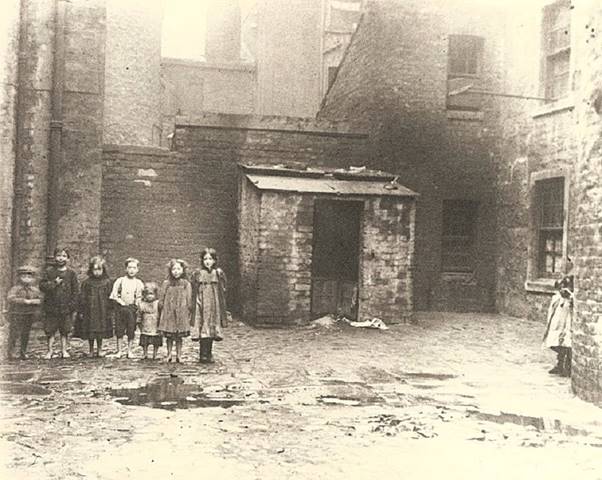
Children gathered in a brick midden in the Gorbals, Glasgow. (Photo: The Glasgow Story.)
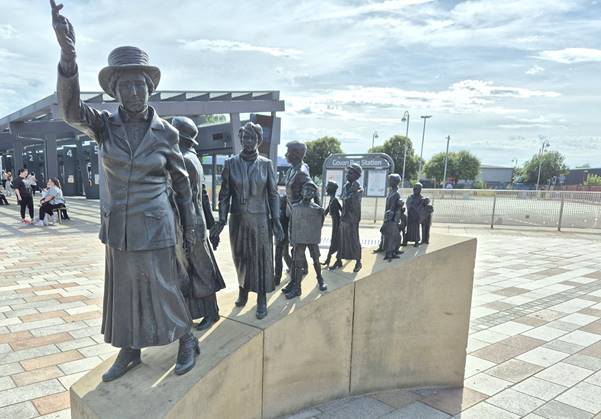
Mary Barbour (1875-1958) was a Scottish political activist, local councillor and magistrate who organised and protested during the Red Clydeside Movement. Her sculpture by Andrew Brown was erected outside Govan subway station in 2018 on International Women’s Day. (Photo: Garry Otton.)
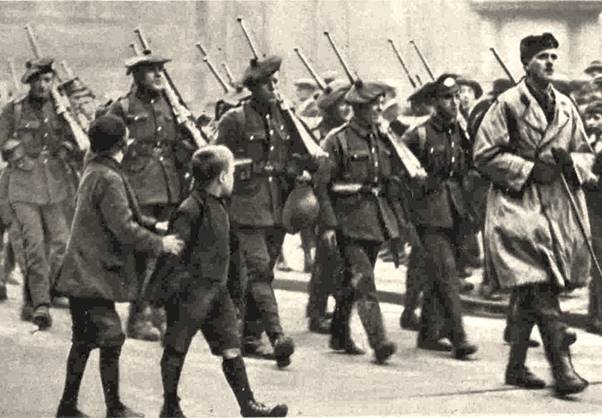
The Independent Labour Party’s May Day Manifesto of 1918 had called for ‘A Living Wage for all and Justice for our Soldiers and their Dependants.’ By the following year there were calls for a 40-hour strike for a 40-hour week which led to the Battle of George Square which saw the deployment of military troops in George Square. The leaders of the Clyde Workers’ Committee were arrested in 1919 and imprisoned under the Defence of the Realm Act.
The deployment of military troops in Glasgow’s George Square, 1919. (Photo: Edinburgh University Press.)
At a time when unemployment grew and riots erupted across the country, stories circulated that foreigners were stealing jobs and housing. In January 1919, rumours circulated around Glasgow that black sailors were “being given the preference in signing on for a ship about to sail.” Instead of going after ship owners taking advantage of cheap labour, thirty African sailors were chased through the streets of Glasgow by a crowd of hundreds.
The media responded disparagingly to the radical left using words like ‘Red Clydeside.’ Only months after the Russian Revolution, the establishment feared a full-scale revolutionary alliance here.
In 1919 after the Great War, crowds had gathered in George Square around a wooden Christian cross to honour those lives lost. It was here, a year later in 1920, that the Lord Provost held a public meeting to announce plans for a permanent war memorial of ‘artistic design.’
Already across the country there was a backlash against the civil elite squandering money on a proliferation of “morbid” stone statues to commemorate the dead.
Glasgow’s War Memorial Committee purposely excluded Labour politicians, trade unions and working class representatives from the committee to ensure the memorial wouldn’t reflect socialist or pacifist sentiments, but appeased the protesting working classes by spending some of the funds on charities helping the veterans: some on the Cenotaph and some on the Prince Albert Memorial Workshops to train disabled sailors and soldiers at Killearn Street in Possilpark. The workshops were named after Prince Albert, later to become King George VI after he wrote to the war memorial committee suggesting they might work on this new Glasgow memorial. The workshops were built in 1905 for homeless men offering them training in such trades as French polishing, furniture making, upholstering, carving, wood machining and shoe making. When this opened after the war in 1919, Prince Albert was welcomed by a guard of honour and the 2nd Battalion Royal Scots and shown around by the Lord Provost and Colonel Smith Park who headed the workshop’s committee. The future king was presented with a carved cigar and cigar box made by the men from the woodwork department.
A few years later, in 1923 the workshops were sold to drink manufacturer, Schweppes.
The inherent patriotism of a grand military monument was seen by Glasgow Corporation – then dominated by a coalition of anti-socialist parties known as the Moderates – as a tool to disadvantage and counter socialist agendas. By framing the narrative around collective British national sacrifice and imperial loyalty, the local government sought to pull working-class focus away from class warfare and redirect it toward civic duty.
Glasgow’s Cenotaph, designed by the architect Sir John James Burnet along with Norman Aitken Dick, featuring sculptures by Ernest Gillick, unveiled in 1924 by Field Marshal Douglas Haig.
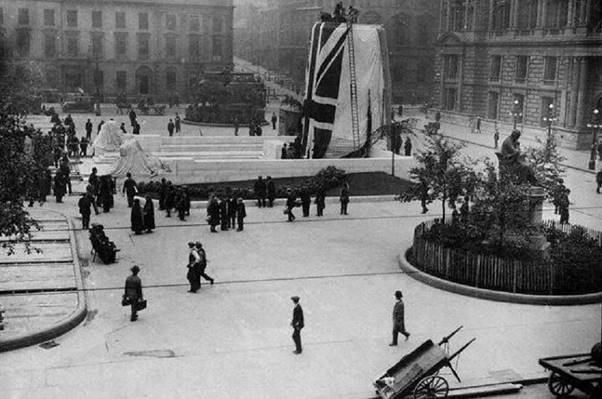
By erecting the Cenotaph directly in front of the City Chambers, the Corporation successfully politicised the war memorial and re-sanctified George Square as a patriotic space. They shifted the area’s identity from a site of anti-government revolt to ‘hallowed ground’ dedicated to the British military state.
Glasgow Cenotaph just prior to its unveiling on 31st May 1924.
Starting in 1925, the Corporation supported massive joint parades by the British Legion and the Combined Regimental Association. These spectacles filled George Square with military pageantry, patriotism, and establishment figures. By institutionalising these remembrance rituals around the Cenotaph, the Corporation successfully crowded out radical political demonstrators who would have thought twice about protesting at a memorial for the victims of war.
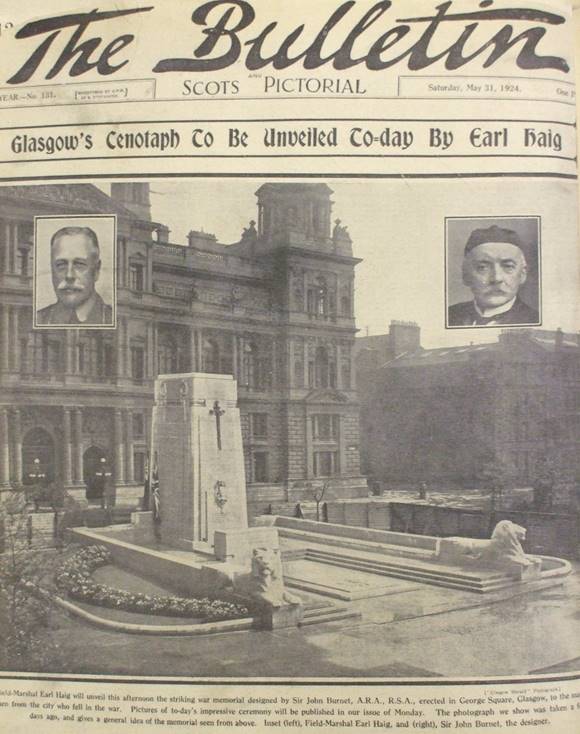
Glasgow’s War Memorial was designed by Glaswegian architect Sir John James Burnet as a squat obelisk flanked by lions to accent the ‘Great Britishness’ of it all. The Glasgow Cenotaph was unveiled on 31 May 1924 by Field Marshal Douglas Haig attended by crowds estimated at around 100,000. Over 60 women had to be treated for fainting and hysteria. Local clergy then offered prayers, dedicating the site as a permanent memorial to Glasgow’s World War I dead. It has been a Category B listed building since 1970 for its architectural and historic interest.
The Bulletin and Scots Pictorial, May 1924 picturing Glasgow’s Cenotaph with Field-Marshall Earl Haig (left) and designer Sir John Burnet (right).
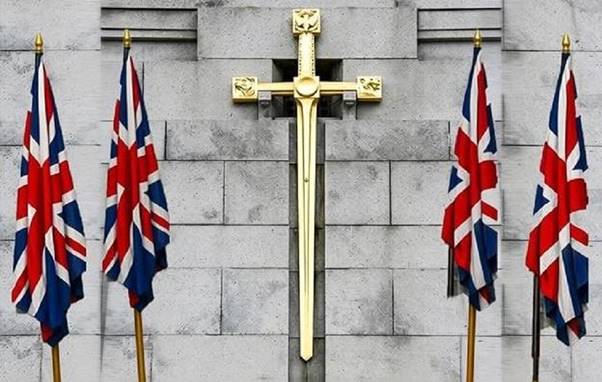
Unlike Edward Lutyens’s secular war memorial in Whitehall, Glasgow’s Cenotaph flew in the face of non-Christians and atheists who gave their lives in the war. A bronze sword, gilded in gold leaf, mimicking a Christian cross adorn the front. Despite some mealy-mouthed explanations that the sword pointed downward represented martial valour and peace, it fools almost no-one: It is unmistakenly a Christian cross. On its website, The Commonwealth War Graves Foundation offer a somewhat baffling explanation on the use of these swords in the cemeteries on the Somme. “The Commonwealth War Graves Commission wished to have something in their sites that would reflect the faith of the majority of soldiers buried in the war cemetery. With its Christian cross shape, the Cross of Sacrifice does just that… Although the cross is a Christian symbol, the Cross of Sacrifice is specially designed so that it can be symbolic to soldiers and visitors of all faiths and religions.”
By placing a cross on the war memorial likens the struggle of the soldiers to a crusade and their sacrifice to the good of mankind, like that of Jesus. Burnet suggested that “the (Glasgow) monument should not only express grief for the fallen but the spirit of sacrifice and achievement.”
The altar-like monument in George Square also features a sculpture of St Mungo, the patron saint of Glasgow, in front of the city’s coat of arms and biblical inscriptions carved in stone and raised lead letters. On the south face it reads: “Greater love hath no man than this, that a man lay down his life for his friends,” from John 15:13, and on the west face there is: “Their name liveth for evermore,” adapted from the Apocrypha, Ecclesiasticus 44:14. The north face carries the simple words: “These died in war that we at peace might live. These gave their best so we our best should give.”
The Chair of the Scottish Secular Society, Neil Gregory has asked: “Who exactly did God save? And can we categorically state that all those who gave their lives in war were Christian? If not, there can be no reason for such a public war memorial having a Christian cross.”
Soon there would be crosses popping up all over the place on memorials reminding the public of those of all faiths and none who gave their lives. The Govan War Memorial used a Mercat Cross opting for a lion instead of the traditional unicorn in a nod to the Union. This too incorporated a Christian cross thinly disguised as a sword on its base.
Govan War Memorial. (Photo: Garry Otton.)
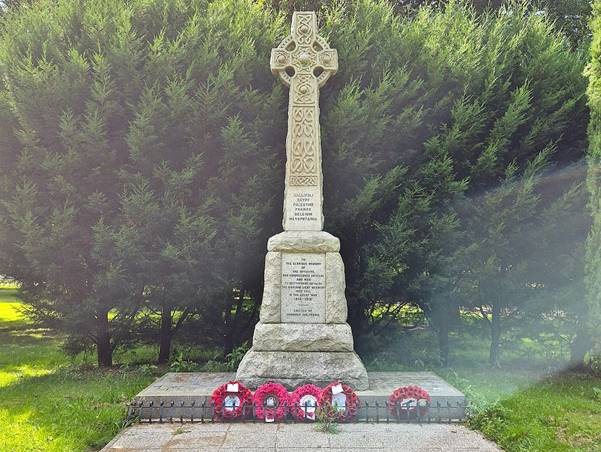
A Celtic Cross was used at the memorial at Burgh Hall in Pollokshaws and for the Dassie Green War Memorial in Glasgow Green honouring the officers, NCOs, and men of the 7th (Blythswood) Battalion, Highland Light Infantry.
The Celtic Cross of Dassie Green War Memorial on Glasgow Green, adjacent to Flesher’s Haugh, an area where Rangers FC played their first game against Callander in May 1872. It was a goalless draw. (Photo: Garry Otton.)
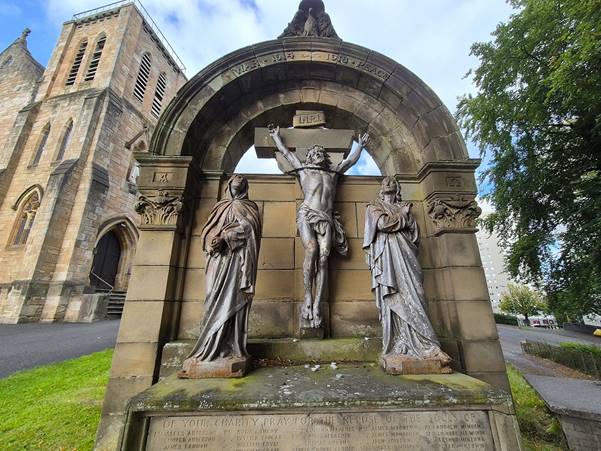
Specifically, for fallen soldiers of the Catholic faith, the war memorial at St Mary Immaculate (St Mary’s & Holy Name) Roman Catholic Church on Shawhill Road, Glasgow was perhaps less appealing to the cultural Catholic as to the very pious and devout, featuring Jesus nailed to the cross flanked by His favourite disciple and His mother.
St Mary Immaculate Roman Catholic Church War Memorial, Pollokshaws, Glasgow. (Photo: Garry Otton.)
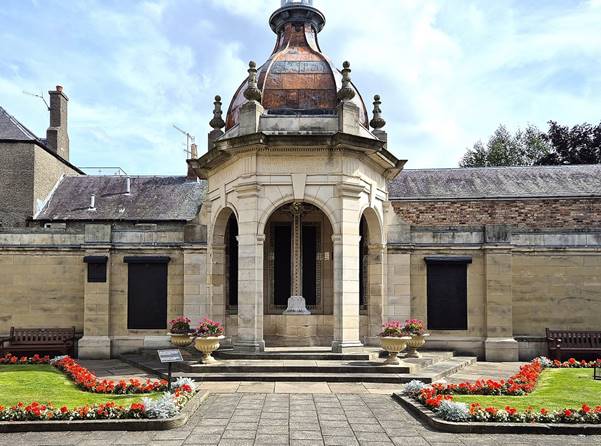
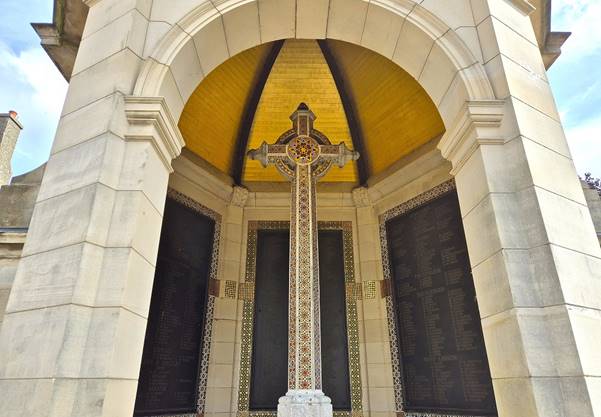
For extravagance, the ogee-domed Renaissance pavilion for the 541 casualties of the Great War in Peeblesshire presents almost like a nouvelle cuisine dish at a Michelin star restaurant! Competition winner, architect Burnett Orphoot proposed in 1919 a war memorial with a cross made of the rare Sicilian Billiemi marble “enriched with mosaics in the colours of those of the Cathedral of Monreale at Palermo” covered by a baldacchino (a stone canopy) coated in copper. He added: “By the use of copper in the canopy and the introduction of the rich Saracenic mosaics on the cross, it is hoped to get a bright note of colour which is otherwise lacking in the surroundings.” The bronze name panels were made by the Bromsgrove Guild of London. Replication of the 12th century Moorish-Byzantine mosaics from Sicily were designed by Professor Giuseppe Matranga of Palermo. As a finishing touch, a giant stylised stone lamp burns as ‘the eternal flame.’
The pleached lime trees, planted to obscure the buildings at the back of the monument had to be removed by 1953 as the walls were not weathering as well as the costs had promised.
Peebles War Memorial outside the Chambers Institution, unveiled in1922 by Field Marshal Earl Haig. (Photo: Garry Otton.)
Peebles War Memorial outside the Chambers Institution designed by Burnett Napier Henderson Orphoot FRIBA (1880-1964). (Photo: Garry Otton.)
In a public space and not necessarily intended for just Christian soldiers, Glasgow’s Cenotaph with its prominent Christian cross has frequently served as a meeting and assembly point for the Protestant Orange Order and allied loyalist groups.
During Black Lives Matter demonstrations of 2020, hundreds of individuals associated with groups like the Loyalist Defence League (LDL) gathered in George Square to ‘protect’ the Cenotaph from protesters and vandalism.
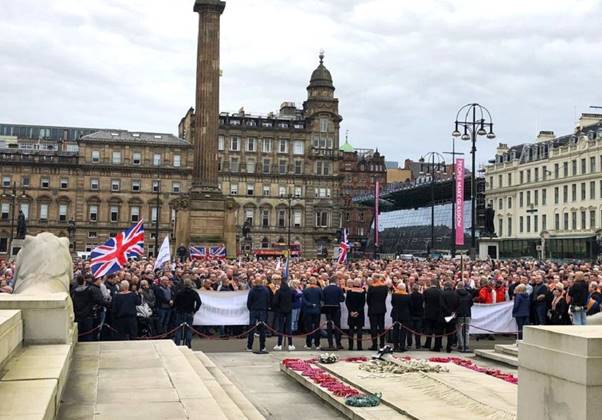
Unpopular Loyalist marches have consistently been a challenge to Glasgow City Council that would prefer to project an entirely different image of the city. On the weekend of 14 September 2019 there were five Loyalist and one Irish Republican parade planned in the city: The Republican Network for Unity, Bridgeton Protestant Boys Flute Band, Pride of the North Flute Band and two marches from the Whiteinch Orange and Purple District. On the Sunday they were to be joined by the Partick Orange and Purple District. After an emergency public processions committee meeting, they ruled that the six parades would be prohibited following advice from Police Scotland. More than a thousand Loyalists, backed by members of the Orange Order descended on Glasgow City Chambers in front of the Cenotaph to protest the council’s ‘illegal’ banning of marches.
Demonstration outside Glasgow City Chambers and the Cenotaph, organised by Scottish Protestants Against Discrimination (SPAD) and backed by the Orange Order against Glasgow City Council’s banning of marches on Saturday, 14 September 2019.
During the Scottish referendum on Scottish independence in September 2014, rioting broke out close to the Cenotaph as Union Jack-waving unionists went on the rampage through the Merchant City even though they had won. Trouble flared when several people draped in union flags arrived and sang “Rule, Britannia!” A flare was set off with mounted police separating the two sides. There were 20 arrests.
Now in Glasgow 2026, after spending £20 million-pounds, George Square has been refurbished into a greener, modern area with new lawns, trees, and benches. But in a nation where the 2022 census saw only 38.8% (and falling) of the total population defining themselves as Christian, the Cenotaph with its Christian cross remains.
Glasgow’s war memorial still performs the patriotic work it was built to perform, but in an age of far-right mobilisation, social-media division and imported culture wars, the sight of Christian crosses and Union Jacks gathered around a civic space of mourning feels increasingly removed from the reason so many Scottish men gave their lives.
Garry Otton 2026. (Author of ‘Religious Fascism’ (The Repeal of Section 28) and co-founder of the Scottish Secular Society.



![Pageflex Persona [document: PRS0000035_00047]](http://garryotton.com/wp-content/uploads/2014/04/ReligFascFrontandBackcover2.jpg)